
Health Tips
9 Science-Backed Health Tips to Lower Cholesterol Naturally (Without Medication)

The content on this website – including articles, event announcements, personal experiences, and recommendations – is for informational and educational purposes only and is not medical advice. Always consult a qualified healthcare professional before making any changes to your diet, exercise, supplements, sleep habits, or wellness routines, especially if you are pregnant, nursing, on medication, or have any medical condition.

Medical disclaimer: This article is for informational and educational purposes only and is not a substitute for professional medical advice, diagnosis, or treatment. Cholesterol management should always be done in partnership with your doctor, who can order a lipid panel, assess your personal and family risk factors, and decide whether medication is appropriate for you. Never stop or adjust a prescribed medication without talking to your healthcare provider first, even if you feel your lifestyle changes are working.
If your doctor just told you your cholesterol is “a little high,” you’re probably doing one of two things right now: panicking a bit, or googling “how to lower cholesterol without medication” before you even think about pills. You’re not alone. A huge number of people want to try lifestyle changes first — and for many people with mild to moderately high cholesterol, that’s a completely reasonable place to start.
Here’s the thing most articles don’t tell you clearly: cholesterol isn’t one number, and it isn’t the enemy. Your body actually needs cholesterol — it builds cell membranes, hormones, and vitamin D. The problem shows up when you have too much LDL (“bad” cholesterol, which sticks to artery walls) and too little HDL (“good” cholesterol, which helps clear it out).
This guide walks through nine changes with real evidence behind them, tells you honestly how long they take to work, and gives you a sample day of eating so you’re not left guessing what to actually put on your plate.
Important disclaimer: This article is for informational and educational purposes only and is not a substitute for professional medical advice, diagnosis, or treatment. Cholesterol management should always be done in partnership with your doctor, who can order a lipid panel, assess your personal and family risk factors, and decide whether medication is appropriate for you. Never stop or adjust a prescribed medication without talking to your healthcare provider first, even if you feel your lifestyle changes are working.
Quick Refresher: LDL, HDL, and Why the Balance Matters

- LDL (low-density lipoprotein): Often called “bad” cholesterol because high levels contribute to plaque buildup in your arteries.
- HDL (high-density lipoprotein): The “good” cholesterol — it helps carry excess cholesterol back to the liver to be removed.
- Triglycerides: A type of fat in your blood, closely tied to diet (especially sugar and alcohol) and weight.
Most of the tips below don’t just lower LDL — several also raise HDL or lower triglycerides, which is why doctors usually recommend a combination approach rather than one single “magic” food.
The Foundation: Dietary Shifts
Tip #1: Embrace Soluble Fiber (The MVP of Cholesterol-Lowering Foods)
Soluble fiber forms a gel-like substance in your gut that binds to cholesterol and bile acids, dragging them out of your body before they can be reabsorbed. It’s genuinely one of the most well-studied natural interventions for LDL — a meta-analysis of 67 controlled trials found that around 3 grams of soluble fiber from oats (about 3 servings of oatmeal) modestly but consistently lowers total and LDL cholesterol [1].
- Best sources: oats and oat bran, beans and lentils, apples, pears, psyllium husk, Brussels sprouts, barley
- How much: Aim for 10–15 grams of soluble fiber a day, on top of your regular fiber intake
- Actionable tip: Stir 1–2 tablespoons of ground flaxseed or a teaspoon of psyllium husk into your morning oatmeal or yogurt
Tip #2: Choose Your Fats Wisely
Not all fat is created equal. Saturated fat (found in red meat, butter, full-fat dairy, and coconut/palm oil) prompts your liver to produce more LDL. Swapping it for unsaturated fat does the opposite.
- Better fats: olive oil, avocado oil, avocados, walnuts, almonds, peanuts
- Actionable tip: Swap butter on toast for mashed avocado or a drizzle of extra-virgin olive oil
Tip #3: Get More Omega-3s
Omega-3 fatty acids don’t lower LDL dramatically on their own, but they’re excellent at lowering triglycerides and calming inflammation in blood vessels, which supports overall heart health.
- Best sources: fatty fish like salmon, mackerel, and sardines (aim for two servings a week), chia seeds, flaxseeds, walnuts
- Note: If you don’t eat fish, an algae-based omega-3 supplement is a reasonable substitute — ask your doctor or dietitian for a dose recommendation
Tip #4: Try Plant Sterols and Stanols
These plant compounds have a similar structure to cholesterol and physically block some of it from being absorbed in your gut. A large meta-analysis of 124 randomized controlled trials (over 9,600 adults) found that daily intakes of 0.6–3.3 grams of plant sterols or stanols lower LDL cholesterol by roughly 6–12%, with stanols in particular showing dose-dependent reductions [2]. Effects are generally measurable within a few weeks of consistent daily use, though the exact timing varies by study.
- Where to find them: fortified spreads, orange juice, and yogurt drinks, or as a standalone supplement
- Actionable tip: Check the nutrition label — you need a consistent daily dose for it to work, not a one-off spoonful
The Game Changer: Lifestyle Modifications
Tip #5: Move More, Sit Less
Exercise is one of the few natural strategies that reliably raises HDL, not just lowers LDL.
- How much: Aim for at least 150 minutes a week of moderate activity — brisk walking, cycling, swimming
- Actionable tip: A 10-minute walk after each meal is an easy way to hit your weekly total without a dedicated “workout block”
Tip #6: Lose Excess Weight, If You Have It to Lose
You don’t need to hit a “goal weight” to see benefits. A large meta-analysis of 73 randomized controlled trials found that for every kilogram of weight lost through lifestyle changes, triglycerides dropped by about 4 mg/dL, HDL rose slightly, and LDL fell by roughly 1.3 mg/dL on average [3] — so a sustained 5–10 kg loss can add up to a meaningful shift. One honest caveat most articles skip: in some large studies, like the Look AHEAD trial in people with type 2 diabetes, LDL’s response to weight loss was less consistent than the improvements seen in triglycerides and HDL [4]. In other words, weight loss reliably helps your overall lipid profile and heart health, even if your LDL number specifically doesn’t always move as much as you’d expect.
Tip #7: Quit Smoking
If you smoke, this is arguably the single most powerful change on this entire list for your cardiovascular health, not just your cholesterol. Smoking specifically lowers HDL, meaning your body has less capacity to clear excess cholesterol from your bloodstream.
Tip #8: Keep Alcohol in Moderation
Excess alcohol raises triglycerides and blood pressure, which works against everything else you’re doing. If you drink, keep it moderate — generally defined as up to one drink a day for women and up to two for men — and talk to your doctor if you’re unsure what’s appropriate for you.
The Secret Weapon: Consistency & Monitoring
Tip #9: Manage Stress and Prioritize Sleep
This is the tip most cholesterol related articles skip entirely, and it’s a real missing information — chronic stress and poor sleep both affect the hormones that regulate how your liver processes cholesterol.
- Simple starting points: a consistent sleep and wake time, 10 minutes of daily mindfulness or slow breathing, a short evening wind-down without screens
Foods to Limit or Cut Back On
- Processed and fatty red meats (bacon, sausage, deli meats)
- Fried foods and fast food
- Full-fat dairy in large amounts
- Baked goods and packaged snacks made with partially hydrogenated oils (trans fats)
- Sugary drinks, which raise triglycerides even if they contain no fat at all
How Long Does It Actually Take to See Results? (A Realistic Timeline)
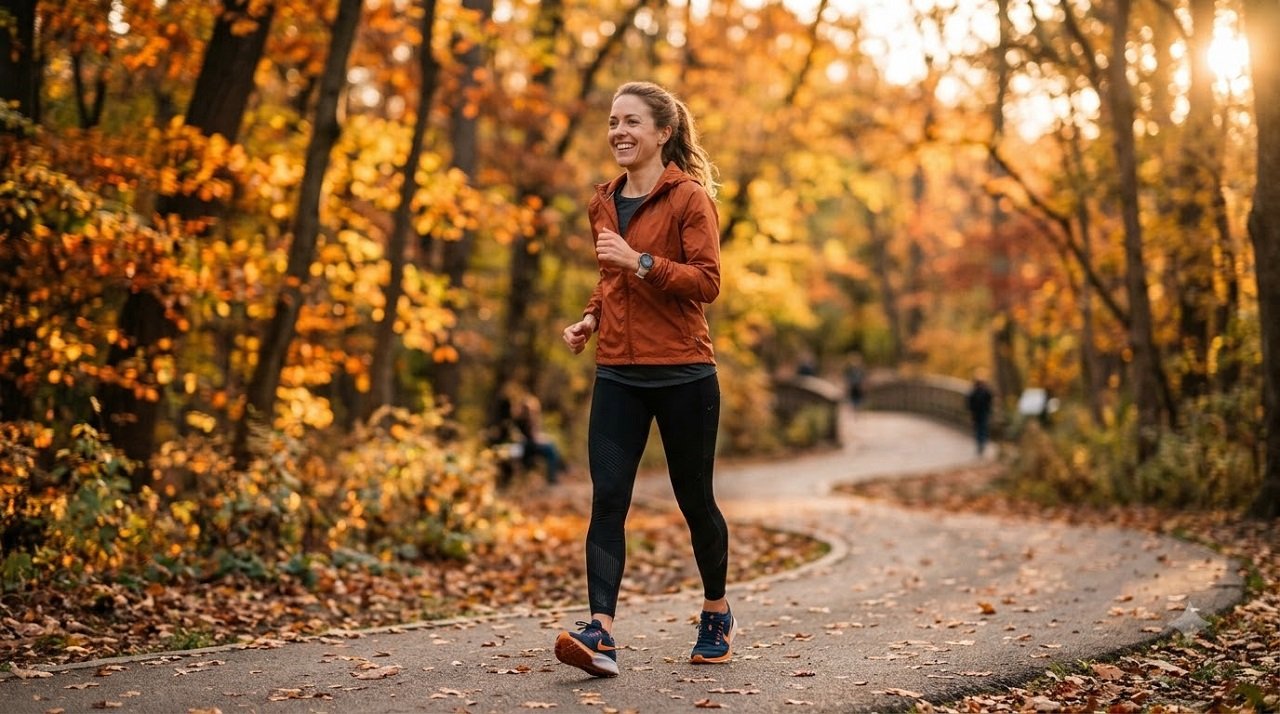
This is the single biggest gap in most cholesterol content online — most articles list tips but never tell you when to expect a change, which leads people to quit too early or expect miracles overnight. Here’s a more grounded picture, based on how different interventions have played out in research:
| Timeframe | What’s Happening |
|---|---|
| Weeks 1–3 | Your body starts adjusting to less saturated fat and more fiber. Lab numbers may not move much yet, but internal changes are underway. |
| Weeks 3–6 | Fast-acting changes tend to show up here. Plant sterol/stanol intake can shift LDL by roughly 6–12% within several weeks of consistent use [2], and cutting saturated fat while adding soluble fiber often produces a similar early trend. |
| Weeks 8–12 | This is typically where diet-driven LDL reductions peak, often in the 10–15% range for people who stay consistent. |
| 3–6 months | The window most doctors use to decide whether lifestyle changes are “working.” Combined diet, exercise, and weight loss can produce meaningfully larger drops than diet alone for people who stick with it. |
Individual results vary a lot based on your starting numbers, genetics, and how strictly you follow the changes — so treat this table as a general guide, not a guarantee, and get retested on the schedule your doctor recommends.
Sample 1-Day Meal Plan (Cholesterol-Friendly)
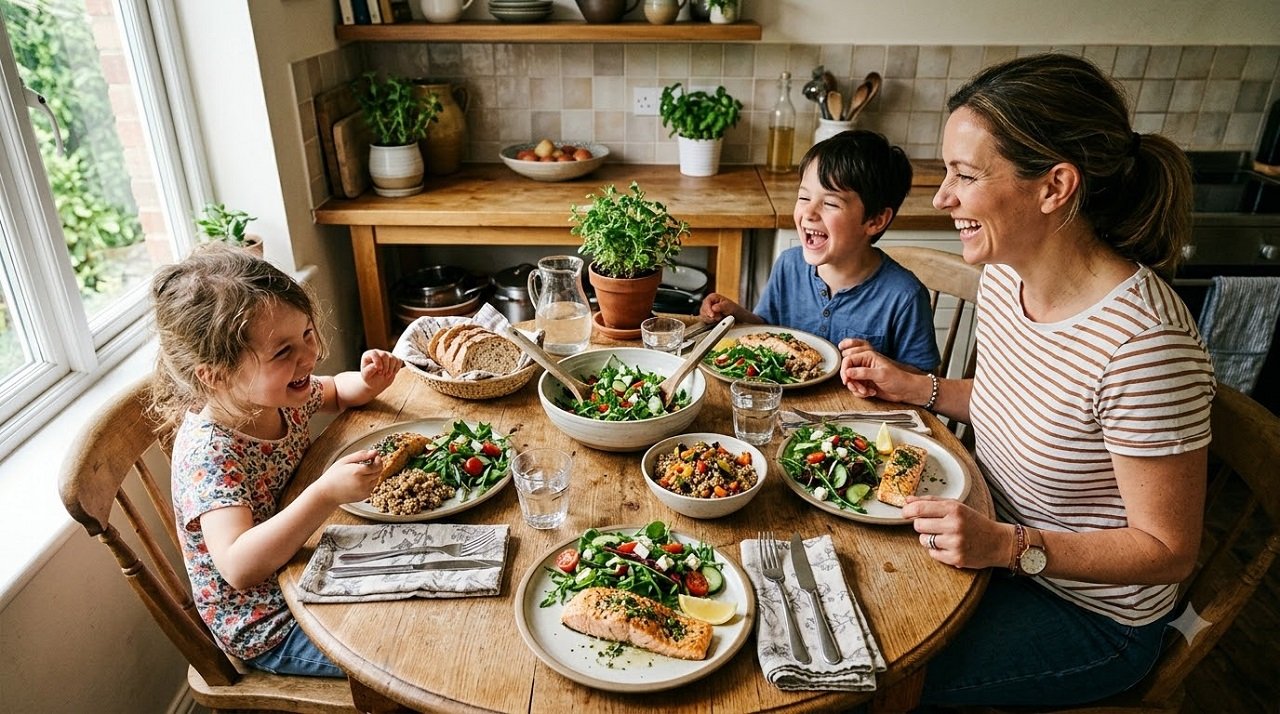
- Breakfast: Oatmeal made with oat bran, topped with sliced apple, walnuts, and a tablespoon of ground flaxseed
- Mid-morning snack: A handful of almonds and an orange
- Lunch: Large salad with mixed greens, chickpeas, avocado, and an olive oil vinaigrette; whole-grain roll
- Afternoon snack: Plain yogurt (or a sterol-fortified yogurt drink) with berries
- Dinner: Grilled salmon, steamed broccoli, and a small serving of barley or quinoa
- Evening: Herbal tea instead of a sugary dessert
When to See a Doctor — and How These Tips Work Alongside Medication
If your cholesterol is only mildly or borderline elevated and you don’t have other major risk factors, your doctor may be comfortable giving lifestyle changes three to six months to work before considering medication. But some people — particularly those with a strong family history of high cholesterol, existing heart disease, diabetes, or very high LDL — may need medication either right away or alongside these changes, not instead of them.
If you’re already on a statin or other cholesterol medication, these tips aren’t wasted effort. They support your heart health, may allow for a lower medication dose over time (a decision your doctor makes, not you), and improve outcomes beyond cholesterol alone, including blood pressure and blood sugar.
Frequently Asked Questions
How long does it take to lower cholesterol naturally?
Most people see the first measurable changes within four to six weeks, with the biggest gains from diet and exercise typically showing up between eight weeks and six months, depending on consistency and starting levels.
What foods lower cholesterol fast?
Soluble fiber (oats, beans, psyllium) and plant sterol–fortified foods tend to act the fastest, with some research showing measurable LDL drops within two to three weeks of consistent use.
Can walking lower cholesterol?
Yes. Regular brisk walking is linked to higher HDL (“good”) cholesterol and can modestly lower LDL, especially when combined with dietary changes and, if needed, weight loss.
How much can lifestyle changes lower cholesterol without medication?
Diet and exercise together can often lower LDL by roughly 10–20% in people who are consistent, though the exact amount depends heavily on starting numbers, genetics, and adherence.
What is a good cholesterol level without medication?
General targets (for adults without other major risk factors) are often cited as LDL under 100 mg/dL and HDL above 40 mg/dL for men or 50 mg/dL for women, but your personal target should be set by your doctor based on your full risk profile.
Can you reverse high cholesterol completely with lifestyle changes alone?
For some people with mild to moderate elevation, yes — lifestyle changes alone can bring numbers into a healthy range. For others, especially those with a genetic predisposition (familial hypercholesterolemia), lifestyle changes help significantly but may not be enough on their own, and medication becomes necessary.
The Bottom Line
Lowering cholesterol naturally isn’t about one dramatic change — it’s about stacking several small, evidence-backed habits and giving them enough time to work. Start with one or two tips from this list, track your progress with regular lipid panels, and partner with your doctor throughout the process. Your heart will thank you for the consistency, even if the number on the page doesn’t move as fast as you’d like.
Scientific References
- Brown L, et al. Cholesterol-lowering effects of dietary fiber: a meta-analysis. American Journal of Clinical Nutrition (PubMed): https://pubmed.ncbi.nlm.nih.gov/9925120/
- Plant Sterols and Plant Stanols in Cholesterol Management and Cardiovascular Prevention (PMC, National Institutes of Health): https://pmc.ncbi.nlm.nih.gov/articles/PMC10343346/
- Weight Loss and Serum Lipids in Overweight and Obese Adults: A Systematic Review and Meta-Analysis (PubMed): https://pubmed.ncbi.nlm.nih.gov/32954416/
- Weight Loss and Improvement in Comorbidity: Differences at 5%, 10%, 15%, and Over — Look AHEAD data (PMC, National Institutes of Health): https://pmc.ncbi.nlm.nih.gov/articles/PMC5497590/
- Cleveland Clinic — 7 Ways To Lower Your Cholesterol: https://health.clevelandclinic.org/how-to-lower-cholesterol
- Harvard Health Publishing — How to lower cholesterol without drugs: https://www.health.harvard.edu/heart-health/how-to-lower-your-cholesterol-without-drugs
- Mechanisms underlying the cholesterol-lowering properties of soluble dietary fibre polysaccharides (PubMed): https://pubmed.ncbi.nlm.nih.gov/21776465/
- Scripps Health — How to Lower Cholesterol Without Medication: https://www.scripps.org/news_items/5641-how-to-lower-cholesterol-without-medication
- MultiCare Vitals — How to Lower Your Cholesterol Without Medication: https://www.multicare.org/vitals/how-to-lower-your-cholesterol-without-medication/












Disclaimer: This article is for informational and educational purposes only and is not a substitute for professional medical or nutrition advice. Protein needs vary based on kidney function, medical history, and individual circumstances. Always consult your prescribing healthcare provider or a registered dietitian before making significant dietary changes, especially if you have chronic kidney disease or other health conditions.
If you are asking how much protein to eat on GLP-1 to prevent muscle loss, you are already ahead of most people on these medications.
The concern is legitimate. Research on GLP-1 therapies consistently shows that a meaningful portion of total weight lost is lean mass, not just fat. A 2026 meta-analysis found that lean-mass loss constitutes 26–40% of total weight lost on GLP-1 receptor agonists. And here is the part that should get your attention: reported protein intake among GLP-1 users falls to approximately 54 grams per day—critically below the threshold needed to protect muscle.-2
You are not failing because you lack willpower. You are failing because nobody told you the number, the timing, or the practical strategy for hitting it when your appetite has been medically suppressed.
This guide gives you the exact targets, the research behind them, and the meal-level tactics to hit them without forcing down food you don’t want.
Why Muscle Loss on GLP-1 Matters More Than the Scale
Muscle is not just “tone.” It is metabolically active tissue. It governs strength, functional capacity, resting metabolic rate, and even how vulnerable you are to weight regain after stopping the medication.
A review published in the European Heart Journal explains that muscle loss with these drugs is multifactorial—related to caloric restriction, anabolic resistance, and hormonal shifts—and raises concerns about sarcopenia, frailty, and metabolic resilience. The authors call for a paradigm shift away from total weight loss toward “high-quality weight loss that preserves or enhances muscle mass”.-61
In simpler terms: the goal is not just to be lighter. It is to be lighter and metabolically stronger. And the two levers that make that possible are protein and resistance training.
Key Takeaways
- The minimum effective dose is 1.2 g/kg of adjusted body weight per day. For most adults on GLP-1, that translates to roughly 80–120 grams of protein daily.
- Most people on GLP-1 eat about 54 grams of protein per day. That is less than half the target for many users.
- Spread protein across meals, not in one sitting. Aim for 0.3–0.4 g/kg per meal, with 2.5–3 g of leucine per meal to trigger muscle protein synthesis.
- Adjusted body weight matters. If you have obesity, calculating protein needs on total body weight can overshoot; adjusted body weight is more accurate.
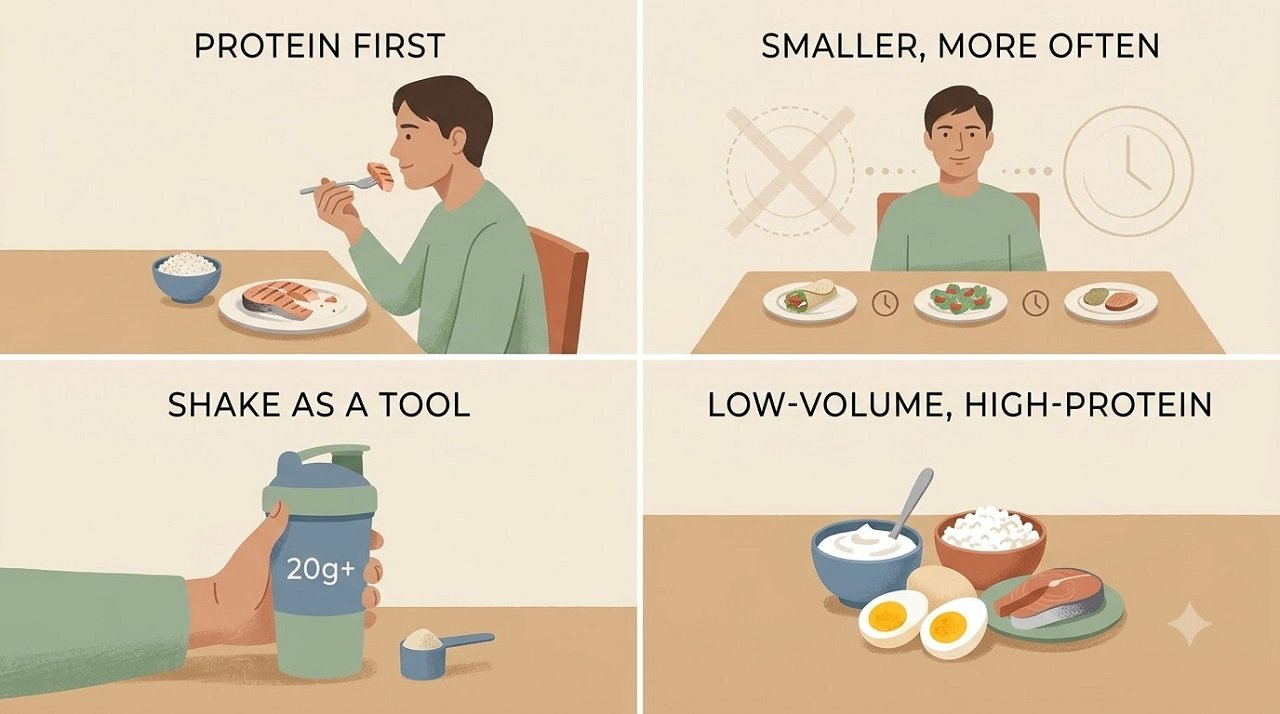
- Protein shakes are a tool, not a failure. If appetite is low, a shake with at least 20 g of protein is a practical bridge.
- Resistance training is the multiplier. Protein without resistance training is necessary but not sufficient. Two to three sessions per week is the research-supported minimum.
- You do not need to force-feed yourself. You need to prioritize protein first at every meal, choose low-volume, protein-dense foods, and supplement strategically.
- Monitor kidney function if you have CKD. Higher protein targets should be individualized with a doctor if you have chronic kidney disease.
1. How Much Protein to Eat on GLP-1: The 1.2–1.6 g/kg Target
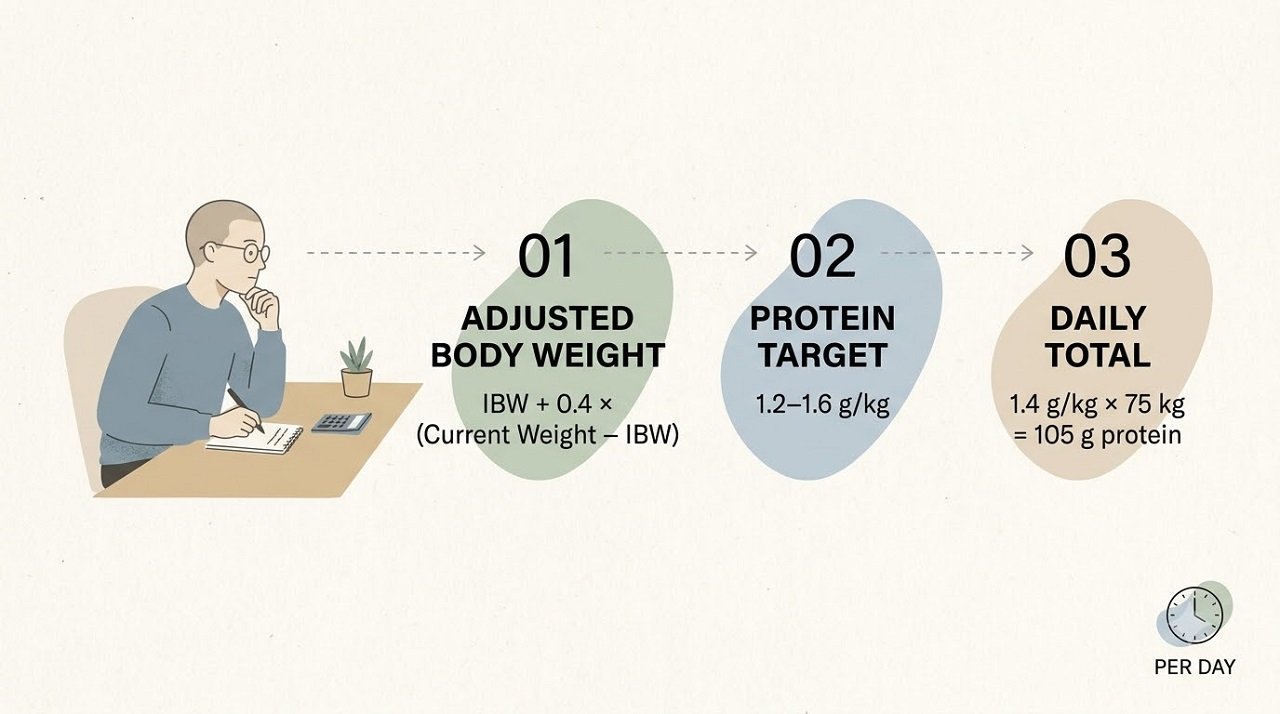
A 2026 narrative review published in Clinical Nutrition ESPEN synthesizes the evidence and provides a practical, dietitian-led framework. The authors recommend daily protein intakes of ≥1.2 g/kg, up to 1.6 g/kg in appropriate adults without chronic kidney disease, with meal-wise targets of 0.3–0.4 g/kg and 2.5–3 g of leucine per meal.-1
A separate study on protein intake in GLP-1 users used 1.2–2.0 g/kg of adjusted body weight as the reference range for hypocaloric diets. And a clinical trial abstract that combined GLP-1 therapy with high-protein guidance and resistance training used 0.8–1.6 g/kg per day as its target range, achieving a mean body weight loss of 15.85% with a relative increase in muscle mass of 5.05%.-10-16
Why adjusted body weight? If you have obesity, calculating protein on total body weight can overestimate needs because fat mass does not require the same protein support as lean mass. Adjusted body weight uses ideal body weight plus a fraction of the excess. Your doctor or dietitian can calculate this for you, but a common formula is: Ideal Body Weight + 0.4 × (Current Weight – Ideal Body Weight).
The practical translation for most adults: 80–120 grams of protein per day, with a floor of at least 60 grams.-5
2. The Timing: Why Spacing Matters as Much as the Total
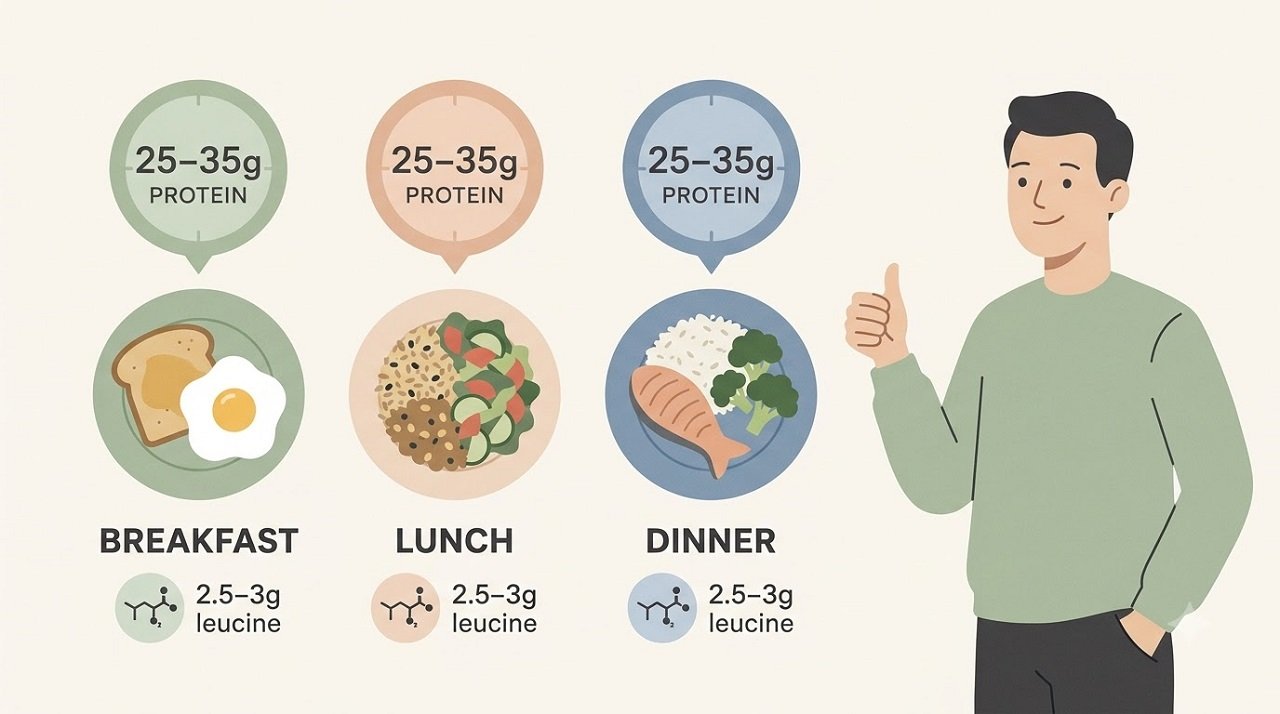
Muscle protein synthesis is not a switch that flips once per day. It is a pulsatile process that responds to each protein feeding. If you eat 80 grams of protein in one meal and nothing the rest of the day, you are not maximizing muscle preservation.
The 2026 Clinical Nutrition ESPEN review recommends meal-wise targets of 0.3–0.4 g/kg, which for a 75 kg adult translates to roughly 22–30 grams of protein per meal. Other clinical guidance recommends beginning each meal with 20–30 grams of protein from foods like fish, beans, chickpeas, or tofu, and aiming for 1.0–1.5 g/kg daily if moderately active.-1-11
The leucine threshold is the reason timing matters. Leucine is the amino acid that acts as the primary trigger for muscle protein synthesis. Research suggests that 2.5–3 grams of leucine per meal is the threshold for maximizing this response in most adults. You do not need to count leucine grams obsessively. You need to ensure each meal has a substantial, high-quality protein source—not just a token amount.-1
A practical meal template:
- Breakfast: Greek yogurt (20 g protein) with berries and nuts, or 2–3 eggs.
- Lunch: A palm-sized portion of chicken, fish, or tofu (25–30 g protein) with vegetables and a slow carbohydrate.
- Dinner: A palm-sized portion of salmon, lean beef, or lentils (25–30 g protein).
- Snack (if appetite allows): Cottage cheese, a protein shake, or a hard-boiled egg.
3. The Reality: Why Hitting the Number Feels Impossible (And What to Do)
Here is the uncomfortable truth: only about 43% of GLP-1 users meet even the minimum protein target of 1.2 g/kg/day, according to a cross-sectional study of 60 adults using GLP-1 receptor agonists for weight loss. And the average intake in that sample was roughly 17.5% of calories from protein—not enough to protect lean mass during rapid weight loss.-10
The problem is not motivation. It is physiology. GLP-1 medications suppress appetite and slow gastric emptying. You feel full faster, stay full longer, and may experience nausea. Forcing down a large chicken breast is not realistic.
The solution is a strategy shift: prioritize protein density over meal volume.
The JAMA Internal Medicine guidance, summarized by University of Maryland Medical System, offers a practical framework: begin each meal with 20–30 grams of protein, and if appetite is very low, use protein shakes with at least 20 grams of protein per serving. Choose low-volume, protein-rich foods such as fish, eggs, Greek yogurt, and cottage cheese. Keep meals small but frequent—smaller meals plus snacks like fruit, a handful of nuts, or unsweetened yogurt—to maintain energy without overwhelming your digestive system.-5-11
The hierarchy of protein-dense, low-volume foods:
- Protein shakes and powders (20–30 g per serving, liquid volume is small)
- Greek yogurt and cottage cheese (high protein per spoonful)
- Eggs (6 g per egg, easy to eat when appetite is low)
- Canned fish, shrimp, and deli turkey (protein-dense, no cooking required)
- Tofu and tempeh (plant-based, versatile)
You are not aiming for a “balanced plate” in the traditional sense. You are aiming for protein first, volume second.
4. The Multiplier: Resistance Training Is Not Optional
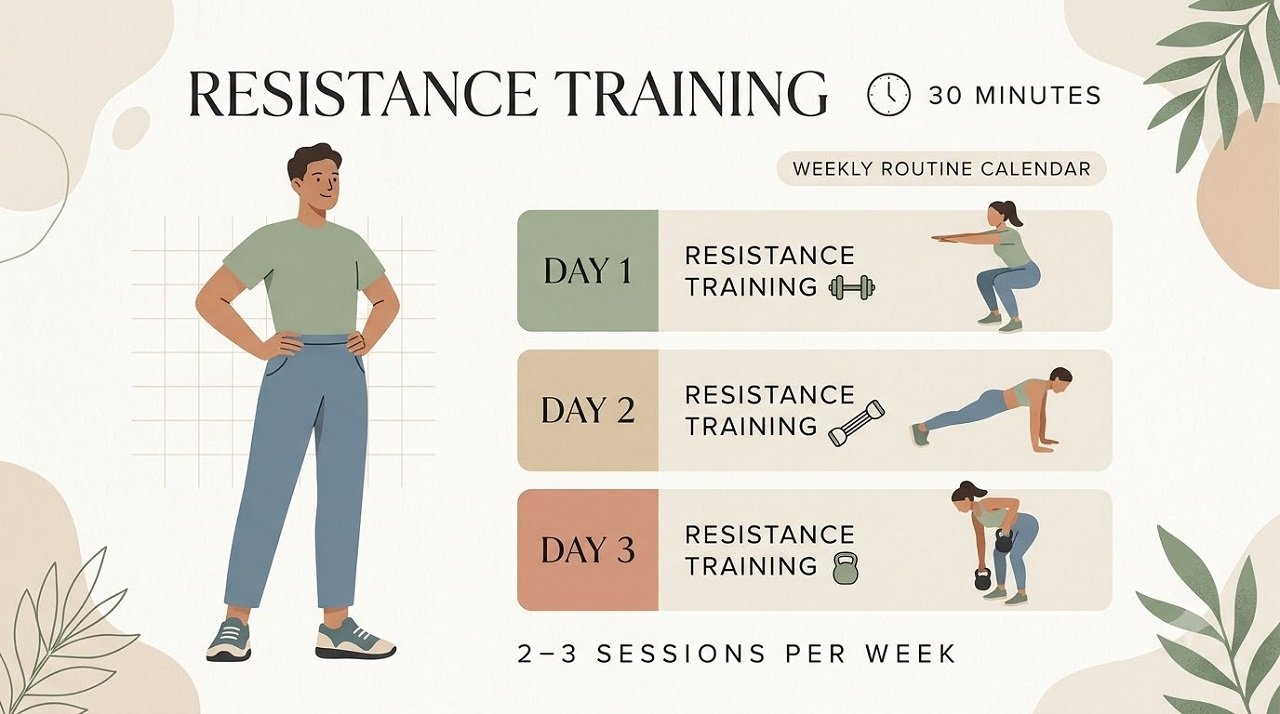
Protein alone will not preserve muscle if you do not give your muscles a reason to hold onto it.
The European Heart Journal review is unequivocal: resistance training is currently the suggested strategy for preserving skeletal muscle and functional capacity during pharmacologic weight loss, while optimized protein intake and other strategies may further mitigate muscle catabolism. A PubMed review on fat, muscle, and anti-obesity medications echoes this, noting that resistance training is the primary strategy and that adjunctive protein optimization can add further benefit.-61
A 2026 endocrine society abstract that combined GLP-1 therapy with high-protein guidance and at least two resistance training sessions per week reported a favorable shift in body composition: fat mass reduced by 5.32% while muscle mass increased by 5.05% over 12 months.-16
The minimum effective dose: Two to three sessions per week, each lasting 30–45 minutes. You do not need a gym. Bodyweight squats, incline push-ups, resistance band rows, and chair dips are sufficient to signal to your muscles that they are needed. The goal is not to become a powerlifter. The goal is to give your body a reason to keep the muscle it has.
5. The Special Cases: When the Standard Numbers Don’t Apply
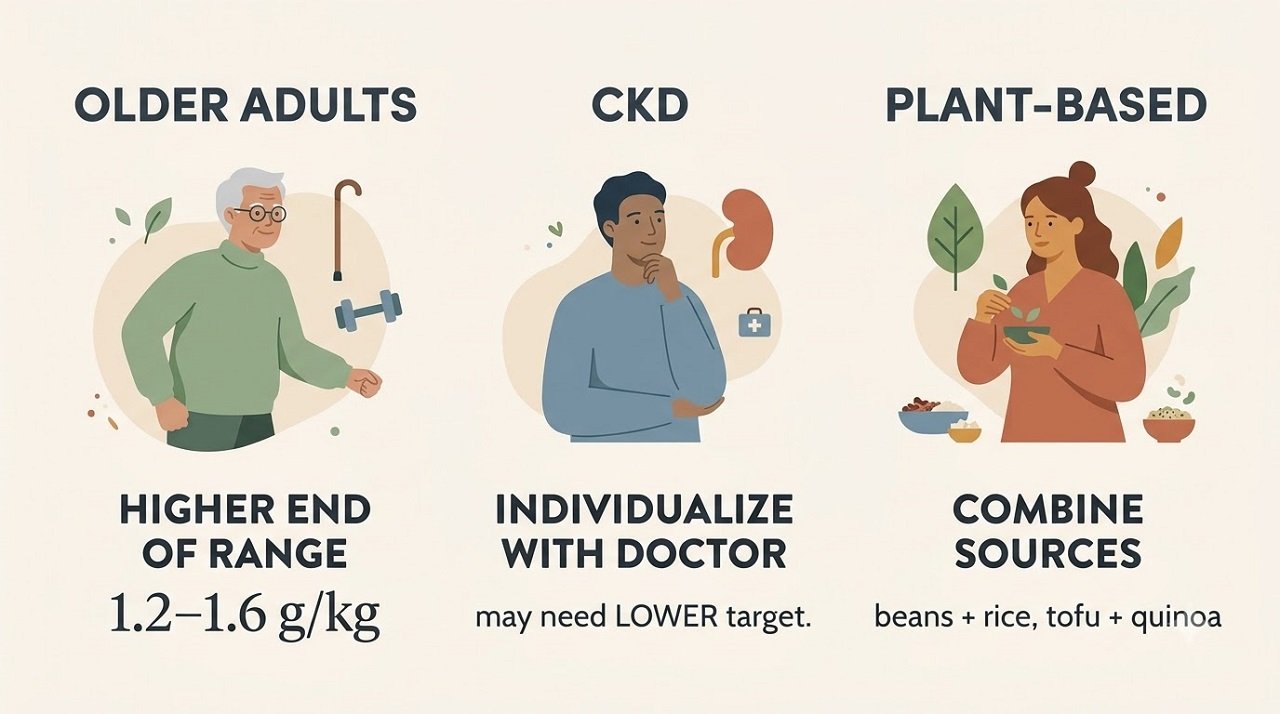
The 2026 Clinical Nutrition ESPEN review specifically addresses adaptations for older adults, type 2 diabetes, chronic kidney disease (CKD), vegetarian/vegan diets, and sarcopenic obesity. The standard numbers are a starting point, not a universal prescription.-1
Older adults: Muscle protein synthesis becomes less responsive to protein intake with age—a phenomenon called anabolic resistance. The review suggests that older adults may need to be at the higher end of the protein range, and the European obesity guideline specifically calls for “particular attention to muscle loss in older adults”.-6
Chronic kidney disease: Higher protein intake may be contraindicated depending on the stage of CKD. The review specifies “up to 1.6 g/kg in appropriate adults without chronic kidney disease”. If you have CKD, your protein target must be individualized with your nephrologist or dietitian.-1
Plant-based eaters: Plant proteins are generally lower in leucine and may be less anabolic than animal proteins. The solution is not to abandon plant-based eating—it is to combine sources (beans with rice, tofu with quinoa) and to be intentional about total intake and leucine content.
Sarcopenic obesity: If you already have low muscle mass and high body fat before starting GLP-1, the stakes are higher. The review flags this population as needing adapted monitoring and potentially more aggressive protein and resistance training targets.-1
6. The Monitoring: How to Know If It’s Working
You cannot manage what you do not measure. The 2026 review recommends monitoring schedules using DXA or bioelectrical impedance analysis (BIA) to track body composition changes, alongside a structured laboratory panel that includes vitamin D, B12, iron studies, folate, zinc, and thiamine in high-risk patients.-1
Practical metrics you can track without a lab:
- Protein intake: Use a simple app for one week to estimate your average daily grams. Most people are shocked by how low it is.
- Strength benchmarks: Can you do more push-ups or squats than you could a month ago? Are daily tasks (carrying groceries, climbing stairs) getting easier or harder?
- Body composition: If available, a DXA scan at baseline and every 3–6 months is the gold standard. BIA scales are less precise but can track trends.
The red flag: If you are losing weight rapidly but your strength is declining, your protein intake is low, and you are not resistance training, you are likely losing more lean mass than necessary. That is the moment to adjust.
The Bottom Line: Protein and Iron, Not Just a Shot
GLP-1 medications are powerful tools. But they are not a complete strategy. The research is clear: without adequate protein and resistance training, a meaningful portion of the weight you lose will be muscle.-2-61
The fix is not complicated, but it requires intention:
- Aim for 1.2–1.6 g/kg of adjusted body weight daily, with a practical target of 80–120 grams for most adults.
- Spread it across meals, with 25–35 grams per meal and a leucine threshold of 2.5–3 grams.
- Prioritize protein-dense, low-volume foods and use protein shakes as a tool when appetite is suppressed.
- Resistance train two to three times per week. This is not optional if muscle preservation is the goal.
- Monitor your strength and, if possible, your body composition. The scale alone does not tell you what you are losing.
You are not just trying to weigh less. You are trying to build a body that is metabolically stronger on the other side of the medication. Protein and resistance training are how you do that.
Frequently Asked Questions
How much protein to eat on GLP-1 to prevent muscle loss?
Most adults on GLP-1 medications should aim for 1.2–1.6 grams of protein per kilogram of adjusted body weight per day, which typically translates to 80–120 grams daily. If you have obesity, calculating on adjusted body weight is more accurate than total body weight. Begin each meal with 20–30 grams of protein.-1-5-11
Does GLP-1 cause muscle loss?
Yes, GLP-1 therapy is associated with lean-mass loss. Research shows that 26–40% of total weight lost on GLP-1 receptor agonists is lean mass, not just fat. This is not unique to GLP-1s—it also occurs with bariatric surgery and intensive calorie restriction—but it is clinically relevant because lean mass supports strength, metabolic rate, and long-term weight maintenance.-2
What protein is best on a GLP-1?
The best protein is protein you can actually eat and tolerate when your appetite is suppressed. Low-volume, protein-dense foods are ideal: Greek yogurt, cottage cheese, eggs, fish, shrimp, and lean poultry. If solid food is difficult, protein shakes with at least 20 grams of protein per serving are a practical tool. Plant-based eaters should combine sources (beans with rice, tofu with quinoa) to ensure adequate leucine intake.-5-11
How do I get enough protein when I’m not hungry?
Protein first at every meal. Take a bite of your protein source before you touch your carbohydrate or vegetable. Eat smaller, more frequent meals rather than three large ones. Keep protein shakes ready for low-appetite days. And do not force-feed—prioritize density over volume.-11
Can I prevent muscle loss on GLP-1 without exercise?
Protein alone helps, but it is not enough. The research consistently identifies resistance training as the primary strategy for preserving muscle during pharmacologic weight loss. Two to three sessions per week of bodyweight or resistance-band exercises is the minimum effective dose.-61
Should I stop GLP-1 if I’m losing muscle?
Do not stop your medication without consulting your prescribing doctor. The goal is not to stop the medication—it is to optimize your nutrition and exercise so that the weight you lose is higher quality. If you are concerned about muscle loss, the conversation to have with your doctor is about protein targets, resistance training, and body composition monitoring—not about stopping treatment abruptly.
Sources
- Johnson, B., McGlasson, T., Thomas, O., Kreider, R., & Jones, R. (2025). Suboptimal protein intake for hypocaloric diet needs while using glucagon-like peptide-1 receptor agonists. Journal of the International Society of Sports Nutrition. https://www.tandfonline.com/doi/10.1080/15502783.2025.2550139
- Medical nutrition in the glucagon-like peptide-1 (GLP-1) era: Protein strategies, micronutrient monitoring, and lean mass preservation. (2026). Clinical Nutrition ESPEN. https://www.sciencedirect.com/science/article/abs/pii/S2405457726004018
- The GLP-1 Nutritional Paradox: A Global Meta-Analysis of Sarcopenic Risks and Micronutrient Gaps in the Post-Obesity Era. (2026). Europe PMC. https://europepmc.org/article/PPR/PPR1311812
- Khan, M. S., et al. (2026). Fat, muscle, and anti-obesity medications in cardiovascular disease prevention. European Heart Journal. https://pubmed.ncbi.nlm.nih.gov/41914150/
- Thompson, D. (2025, July 16). Experts recommend healthy lifestyle changes alongside GLP-1 drug use. Medical Xpress. https://medicalxpress.com/news/2025-07-experts-healthy-lifestyle-glp-drug.html
- SAT-719 – Mitigating Sarcopenic Risk in GLP-1 Pharmacotherapy: Impact of a Multi-Pillar Digital Metabolic Reset Program on Muscle Mass Preservation. (2026). Endocrine Society. https://endo2026.endocrine.org/fsPopup.asp?PresentationID=1845247&mode=presInfo
- How Much Protein Should I Eat on a GLP-1? (2026). Ro. https://ro.co/weight-loss/how-much-protein-to-eat-glp-1/
- European obesity guideline: pair GLP-1s with nutrition, muscle, mental health. (2026). Epocrates. https://www.epocrates.com/online/article/european-obesity-guideline-pair-glp-1s-with-nutrition-muscle-mental-health

Disclaimer: This article is for informational and educational purposes only and is not a substitute for professional medical or mental health advice. If you are struggling with persistent anxiety, depression, disordered eating, or chronic health issues, please reach out to your campus health center or a licensed healthcare provider.
Let’s be honest about the standard “student health” advice you’ve probably already scrolled past.
“Get 8 hours of sleep.” “Meal prep on Sundays.” “Go to the gym for an hour.”
If you’re a student juggling lectures, assignments, a part-time job, a social life, and the low-grade panic of an upcoming deadline, that advice doesn’t just feel unrealistic—it feels like another item on your to-do list that you’re already failing.
The real problem isn’t that students don’t care about their health. It’s that most wellness content ignores the actual constraints of student life: inconsistent schedules, tight budgets, shared kitchens, and a nervous system that’s running on caffeine and cortisol.
This guide is different. Every tip below is designed for the reality of a busy student schedule. Each one is backed by research, takes less than 15 minutes to implement, and doesn’t require a gym membership, a blender, or a Sunday devoted to meal prep.
Why Generic Health Advice Fails Students (And What the Research Actually Says)
The conventional wisdom assumes you have two things most students don’t: predictable blocks of free time and unlimited energy.
Research on student stress and coping reveals something important. A qualitative study of baccalaureate students found that time management struggles directly interfere with finding time for exercise, healthy eating, and social connection—and that adjusting perfectionistic expectations is a deliberate, effective coping strategy. In other words, the pressure to “do health perfectly” can itself become a source of stress.
The evidence points toward a different approach: small, frequent, low-friction actions that interrupt sedentary behavior and stabilize energy, rather than grand overhauls that collapse the moment a deadline hits.
That’s the framework for everything below. Not perfection. Interruption.
Key Takeaways
- Sleep regularity beats sleep perfection. A consistent 7.5-hour schedule is better than irregular swings between short weekdays and long weekend recovery sleep.
- Exercise snacks work. Brief bursts of movement (30 seconds to 2 minutes) throughout the day improve energy metabolism and academic focus—no gym required.
- One “base” meal beats a perfect meal plan. Batch-cook one versatile protein-and-carb foundation, then vary toppings across the week.
- Hydration is a cognitive tool. Keep a visible water bottle on your desk. Dehydration impairs concentration and alertness.
- 5-minute nervous system resets are enough. Box breathing and cyclic sighing activate the parasympathetic nervous system before exams or presentations.
- Study breaks need movement, not scrolling. A 10-minute movement break restores focus; a phone break does not.
- Schedule health as a non-negotiable task. Treat meals, movement, and sleep as conditions for productivity—not rewards for finishing work.
- Protect your first and last hour. Consistent morning and evening routines signal your body when to ramp up and when to shut down.
- Eat for stable energy. Pair carbohydrates with protein or healthy fat to avoid the afternoon crash.
- Social connection is a health behavior. A 10-minute coffee with a friend is a nervous-system intervention, not wasted time.
- Self-care is maintenance, not reward. Brushing your teeth, drinking water, and going to bed on time are self-care.
- Know when to get help. Save your campus counseling center number before you need it.
1. Prioritize Sleep Regularity Over “Sleep Perfection”
This is the single most important mindset shift in this article.
Most students obsess over how many hours they sleep. But emerging research suggests that sleep regularity—going to bed and waking up at roughly the same time each day—may be an equal or even stronger predictor of long-term outcomes than total sleep duration. One analysis notes that “a consistent seven-and-a-half-hour schedule is usually a better target than irregular swings between short weekdays and long weekend recovery sleep.”
This matters for students because the “sleep debt” model (staying up all week, sleeping until 2 PM on Saturday) actually disrupts your circadian rhythm further. Research on college students specifically links inconsistent sleep schedules to lower sleep quality and symptoms of depression.
The actionable tip: Pick a wake-up time you can hit every day, including weekends. Anchor your bedtime to it. If you must choose between a perfectly early bedtime and a consistent one, choose consistency.
Sleep hygiene fundamentals still matter—limit caffeine at least six hours before bed, avoid screens for the last hour, and keep your room cool (around 60–67°F). But regularity is the foundation.
2. Use “Exercise Snacks” Instead of Waiting for a Workout Window
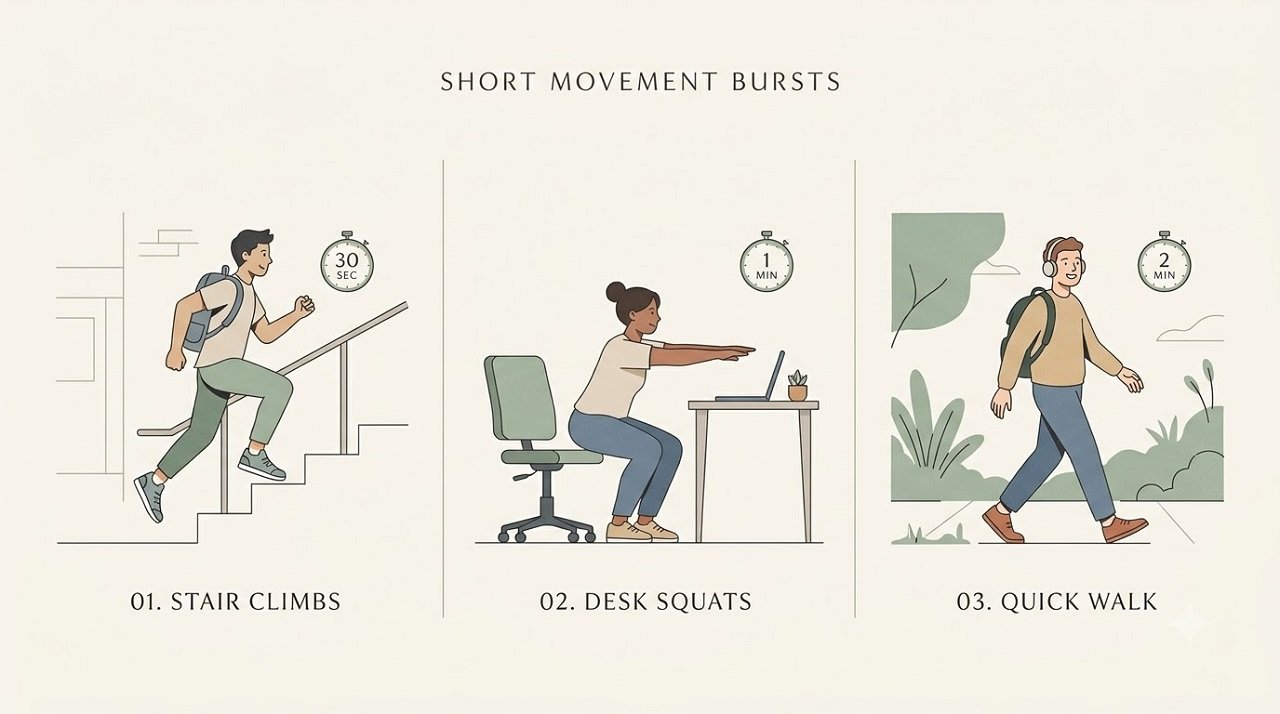
You do not need a 60-minute gym session to get the cognitive and mood benefits of movement.
A growing body of research on “exercise snacks”—brief, vigorous bouts of movement (often under one minute) performed throughout the day—shows measurable benefits for fitness and metabolic health in sedentary college students. One study found that a two-minute exercise snack may be sufficient to increase energy expenditure and fat oxidation, triggering sustained post-exercise metabolic activation. Clinical trials are actively investigating exercise snacks as a time-efficient strategy for improving aerobic capacity, muscle function, and even academic stress.
The practical version is almost embarrassingly simple. Rochester University’s health guidance for busy students recommends walking or biking to class, using a bathroom farther from where you study, and taking study breaks that involve movement—a 10-minute walk, or bodyweight squats and push-ups.
Micro-workouts you can do between lectures or study blocks:
- 30 seconds of stair sprints, repeated 3–4 times
- 10 chair squats and 10 incline push-ups against your desk
- A brisk walk around the building while listening to a podcast
The goal is interruption, not exhaustion. Every time you break up a long sitting session, you’re sending a small signal to your body that it is not, in fact, a piece of furniture.
3. Build Meals Around a “Base,” Not a “Meal Plan”
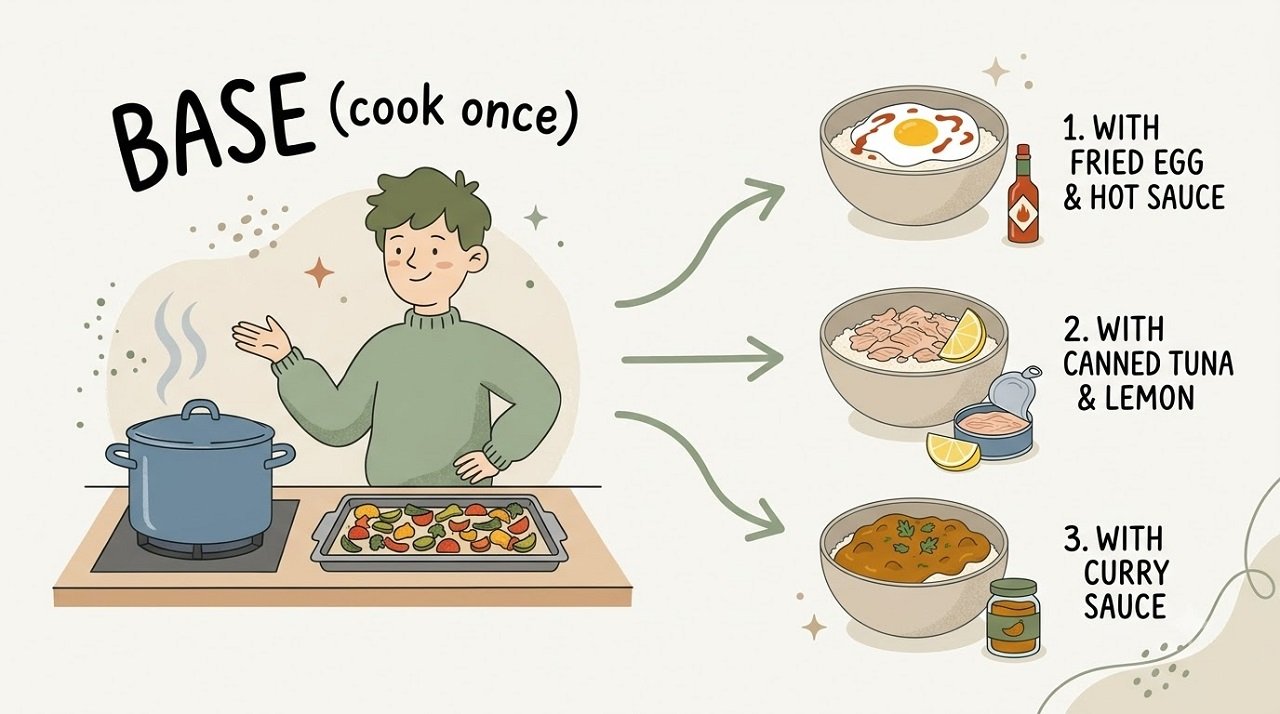
Meal prep advice is often written for people with a full kitchen and a free afternoon. Students have neither.
The smarter approach is to build a “base” strategy: cook or assemble one versatile, cheap protein-and-carb foundation in a batch, then vary the toppings and sauces throughout the week so you don’t get bored.
The evidence supports this. The American Medical Association’s guidance for students recommends batch cooking precisely because “a single batch-cooking session each week can provide multiple healthy meals, making nutritious choices more convenient even during the busiest days.” Budget-friendly student meal resources consistently highlight the same principles: frozen vegetables, canned beans and fish, eggs, oats, rice, and lentils as the backbone of cheap, nutrient-dense eating.
A realistic example:
- Base: A pot of rice or lentils, plus a tray of roasted frozen vegetables and chicken thighs (or canned chickpeas).
- Variations across the week: Day 1, add a fried egg and hot sauce. Day 2, add canned tuna and lemon. Day 3, add a jar of curry sauce.
- Emergency backup: Greek yogurt, fruit, and granola (a dorm-friendly parfait rich in protein and probiotics).
You are not aiming for a Pinterest-perfect meal plan. You are aiming for one less decision on a day when your brain is already full.
4. Treat Hydration as a Cognitive Tool, Not a Chore
Dehydration doesn’t just make you thirsty. It makes you foggy.
Research on hydration and cognitive function in students indicates that hydration status affects concentration and alertness, and that adequate hydration is essential for optimal cognition. Studies on school-aged populations have found beneficial effects of supplemental water intake on short-term memory and attention, with researchers suggesting that focusing on adequate hydration over time—not just chugging water when you remember—may be key for cognitive enhancement.
The student-friendly execution is simple: keep a visible water bottle on your desk. Not in your bag. Not in the kitchen. On the desk, in your line of sight. Sip during lectures and study blocks. If plain water is boring, herbal tea or warm lemon water counts toward your fluid intake.
One study also found that students who were dehydrated were more likely to feel less alert and less able to concentrate during the school day. If you’re reading the same paragraph three times and nothing is sticking, drink a glass of water before you reach for another coffee.
5. Use 5-Minute Nervous System Resets (Not Just “Relaxation”)
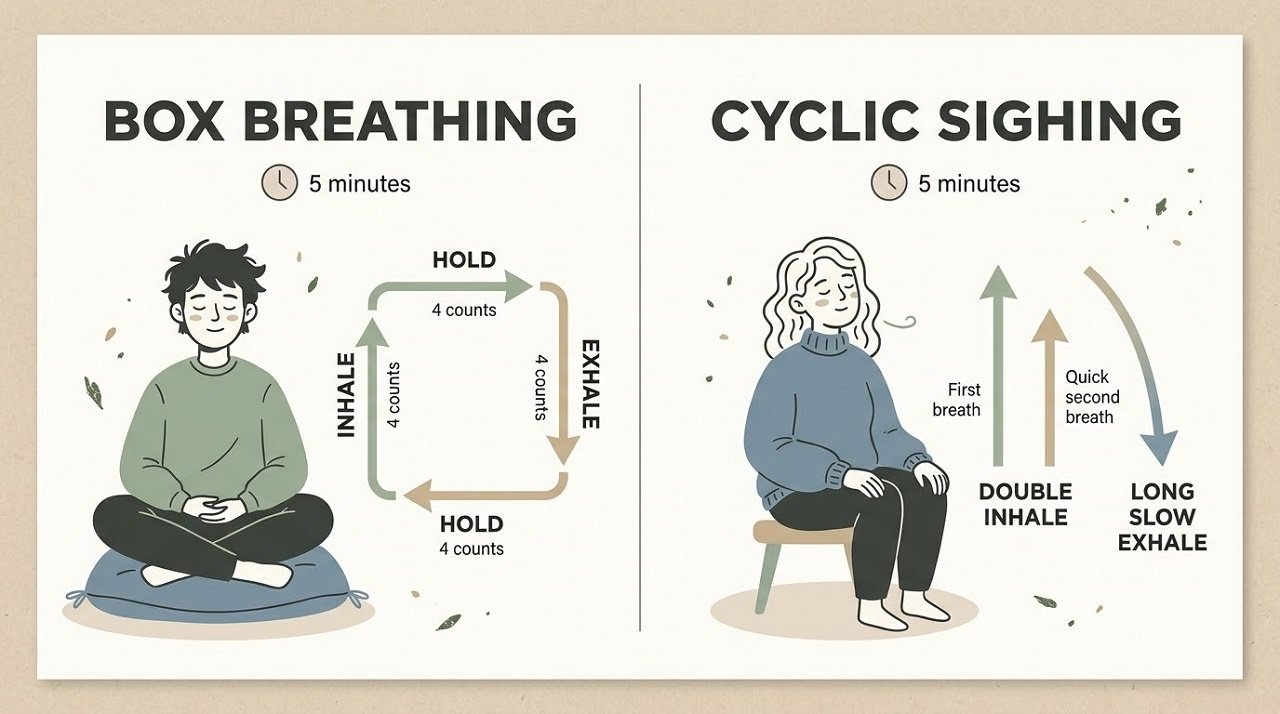
“Manage your stress” is useless advice. Your nervous system needs a signal to downshift, not a vague instruction.
Research on student stress interventions supports structured, brief breathing practices as an effective way to improve emotional regulation and academic performance. One study found that cyclic sighing and box breathing, practiced for just five minutes daily, may offer a simple and effective approach to enhance emotional regulation and well-being. Other research has shown that a five-minute guided breathing exercise before an exam can have a beneficial effect on students’ emotional state.
The 5-minute reset protocol:
- Box breathing: Inhale for 4 counts, hold for 4, exhale for 4, hold for 4. Repeat for 5 minutes.
- Cyclic sighing: Inhale through the nose, then take a second short inhale to fully expand the lungs, then exhale slowly and completely through the mouth. Repeat.
These techniques activate the parasympathetic nervous system—the “rest and digest” branch—which is the physiological opposite of the fight-or-flight state you’re in when you’re staring at a deadline. Five minutes is enough to shift the state. You can do it in a library bathroom stall, before a presentation, or with your eyes closed at your desk.
Additional anti-burnout strategies from student mental health research include making time for things you enjoy outside of learning, creating to-do lists to externalize the mental load, changing where you study to break associative stress loops, and reaching out to a friend, instructor, or campus support service when you’re feeling overburdened. The key is to have a menu of resets ready before you need them.
6. Build a “Movement Snack” Routine Into Your Study Breaks
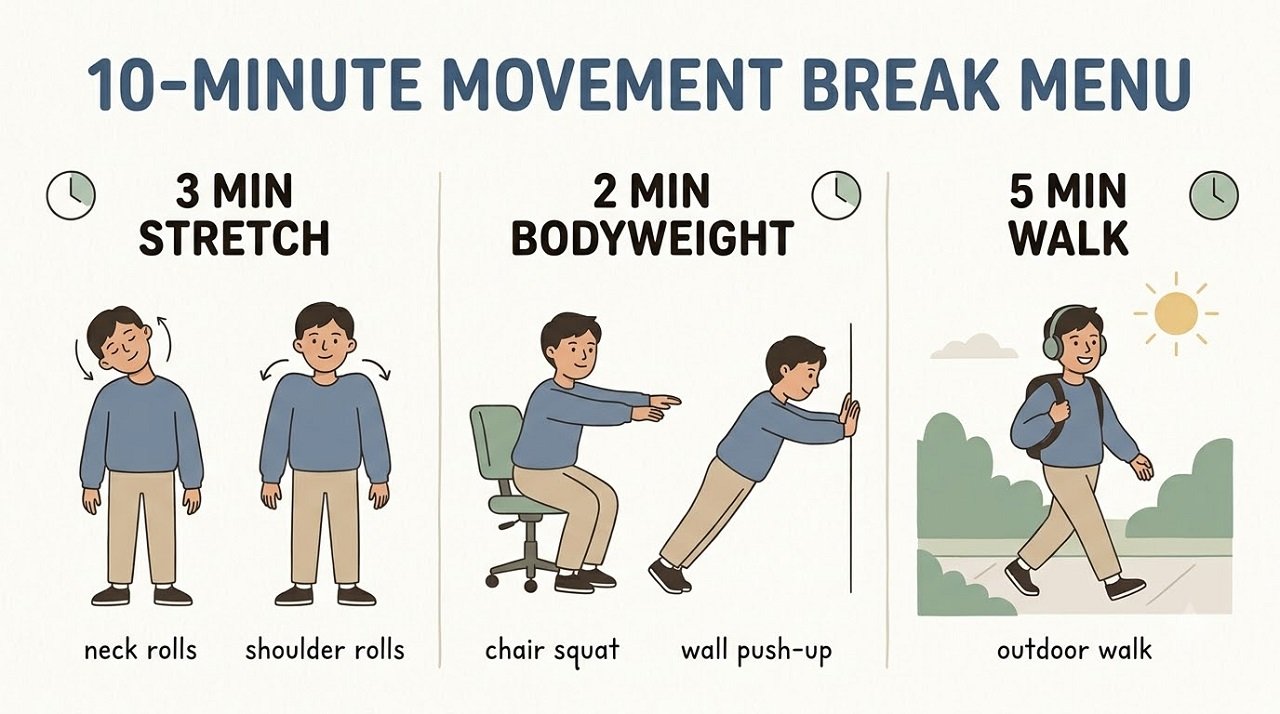
This is distinct from exercise snacks because the goal is not fitness—it’s focus restoration and tension release.
Study breaks that involve movement are repeatedly recommended in student health guidance. Rochester University suggests using study breaks to “reset and clear your head with a 10-minute walk” or bodyweight exercises. CampusWell’s chair workout routine is designed specifically for between study sessions, requiring only a stable chair and a few minutes.
A 10-minute movement break menu:
- 3 minutes of stretching: neck rolls, shoulder rolls, cat-cow, leg swings
- 2 minutes of bodyweight movement: squats, wall sit, incline push-ups
- 5 minutes of walking—ideally outside, ideally with music or a podcast
The point is not to “burn calories.” The point is to change your physical state so your brain can re-engage. A study break that consists of scrolling on your phone is not a break for your nervous system; it’s just a different kind of input.
7. Use Time Blocking With “Personal Tasks” Built In
The students who manage their health best are not the ones with the most free time. They are the ones who schedule health behaviors as non-negotiable blocks, not as things that happen if there’s time left over.
Research on student coping emphasizes that time blocking and goal setting are effective strategies for balancing academics and well-being. A practical framework from medical school guidance suggests structuring your daily tasks into three tiers:
- One major task (urgent and important)
- Three moderate tasks (flexible or less time-sensitive)
- Five small personal tasks—for example, adequate sleep, proper meals, or time with loved ones
That last category is the one students skip. Don’t skip it. Treat “eat lunch away from my desk” or “walk for 10 minutes after my afternoon lecture” as tasks on the same list as your essay. They are not rewards for productivity. They are the conditions that make productivity possible.
8. Protect Your First and Last Hour (The “Sleep Bookends”)
You cannot control everything that happens during a busy day. You can control how you enter and exit it.
Sleep hygiene research emphasizes the importance of a wind-down routine—reading, light stretching, or another calming activity that signals to your body that sleep is coming. The inverse is also true: a morning routine that doesn’t begin with immediately opening your phone and flooding your brain with input.
The bookend protocol:
- First hour: Wake up at a consistent time. Drink water before caffeine. Get 5 minutes of natural light (open the curtains, step outside) to anchor your circadian rhythm.
- Last hour: Dim the lights. Put screens away (or at least use a blue-light filter). Do something low-stakes and pleasant: read, stretch, listen to a podcast, or do your 5-minute breathing reset.
This is not about being a “morning person” or a “night person.” It’s about giving your body predictable transition signals so it doesn’t have to guess when to ramp up and when to shut down.
9. Eat for Stable Energy, Not Just “Healthy” Labels
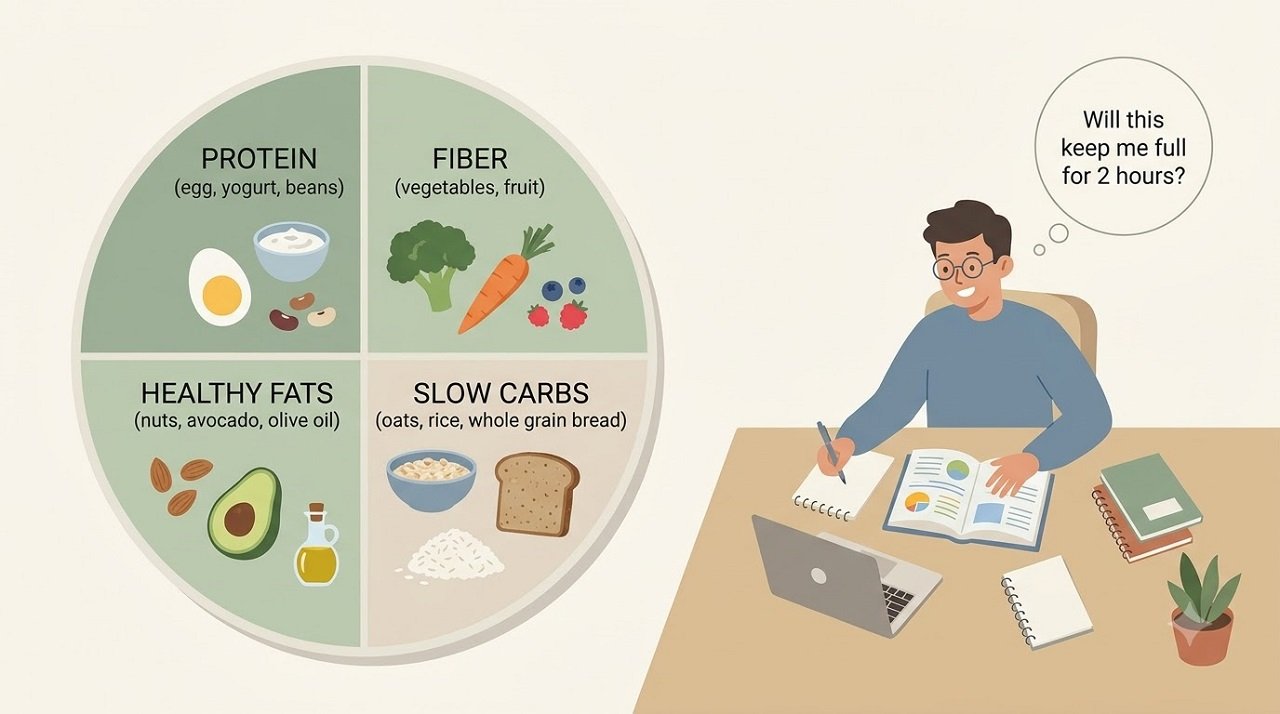
A “healthy” meal that spikes your blood sugar and crashes an hour later is not helping you study.
The goal is stable energy: protein, fiber, and healthy fats at each meal, with carbohydrates that digest slowly. Student-friendly examples from budget meal resources include oats with peanut butter and banana, lentil soup, bean quesadillas, and yogurt parfaits with fruit and granola.
A simple rule for busy days: If a meal or snack is going to be your study fuel, ask one question: “Will this keep me full for at least two hours?” If the answer is no (a bag of chips, a sugary coffee drink, a plain granola bar), add a protein or fat source—a handful of nuts, a spoonful of peanut butter, a hard-boiled egg, or a cheese stick.
You don’t need to track macros. You just need to avoid the crash that steals your afternoon focus.
10. Make Social Connection a Health Behavior (Not a Luxury)
Loneliness and isolation are health risks, not just emotional inconveniences. Student mental health guidance consistently emphasizes expanding support networks and opening up to family, friends, and others as a core stress-management strategy.
But here’s the student-specific challenge: when you’re busy, social connection is the first thing you cut. That’s backward.
Research on stress and coping among students identifies seeking social support as a problem-focused coping strategy—meaning it directly addresses the stressor rather than just distracting from it. A 10-minute coffee with a friend, a walk with a roommate, or a phone call with family is not “wasted time.” It’s a nervous-system intervention that makes the rest of your work more sustainable.
The micro-connection tip: Schedule social time the same way you schedule study time. A standing 20-minute lunch with a friend once a week is more reliable than waiting for a free afternoon that never comes.
11. Redefine “Self-Care” as Maintenance, Not Reward
The wellness industry has taught us that self-care is a bubble bath or a treat. For students, that framing is unhelpful because it turns health into something you earn after you’ve burned yourself out.
A more useful definition: self-care is the maintenance work that keeps you functional. Brushing your teeth is self-care. Drinking water is self-care. Going to bed at a consistent time is self-care. Taking a 5-minute breathing break before an exam is self-care.
Johns Hopkins University’s student well-being framework uses the acronym SNACKS—Sleep, Nutrition, Activity, Connectivity, Knowledge, and Self-care—to emphasize that well-being is built from small, repeated behaviors, not grand gestures. The message is not “do more.” It’s “notice what you’re already doing, and protect the basics.”
12. Know When to Get Help (And Where)
No article can replace professional support. If you are experiencing persistent low mood, overwhelming anxiety, disordered eating, or thoughts of self-harm, reaching out is the healthiest thing you can do.
Most campuses offer free or low-cost counseling services, health centers, and well-being coaching. Johns Hopkins, for example, offers well-being consultations and coaching to help students improve sleep, goal setting, and behavior change. Rochester University frames exercise as a mental health tool, citing research that higher physical activity is associated with lower risk of depression—but also acknowledges that professional support is a valid and important part of the picture.
The student-specific tip: Find out where your campus counseling center is before you need it. Save the number in your phone. Knowing the door is there makes it easier to walk through it.
The Bottom Line: Interrupt, Don’t Overhaul
The biggest lie in student wellness content is that you need a perfect routine to be healthy.
You don’t. You need small, repeatable interruptions to the patterns that drain you: a 2-minute movement snack between lectures, a glass of water before your third coffee, a consistent wake-up time, a 5-minute breathing reset before an exam, and a base meal in the fridge so you’re not making decisions on an empty tank.
None of these are dramatic. All of them are evidence-backed. And together, they add up to something more powerful than a perfect plan you abandon by week two: a sustainable baseline.
Start with one. The one that feels easiest. Then stack another. That’s how health actually happens for busy students—not in a grand transformation, but in the quiet decision to interrupt the slide.
Frequently Asked Questions
How can a busy student stay healthy?
Focus on small, repeatable actions rather than a perfect routine. Research supports prioritizing sleep regularity (consistent bed and wake times), brief “exercise snacks” (30 seconds to 2 minutes of movement throughout the day), keeping a visible water bottle on your desk, and building meals around a pre-cooked “base” ingredient. The goal is interruption of sedentary patterns, not a complete lifestyle overhaul. Even a 5-minute breathing reset before an exam can meaningfully improve emotional regulation.
What are 5 simple wellness tips for students?
- Wake up at the same time every day — including weekends. Sleep regularity may matter more than total hours.
- Keep a water bottle on your desk — not in your bag. Dehydration impairs concentration and alertness.
- Take a 2-minute movement snack between lectures — stair sprints, chair squats, or a brisk walk.
- Use box breathing for 5 minutes before a presentation or exam to activate your parasympathetic nervous system.
- Eat for stable energy — pair carbohydrates with protein or healthy fat to avoid the afternoon crash.
How do you balance health and studies?
The students who manage both best don’t have more free time—they schedule health behaviors as non-negotiable blocks. A practical framework is to structure each day with one major academic task, three moderate tasks, and five small personal tasks (adequate sleep, proper meals, time with loved ones). Treat “eat lunch away from my desk” or “walk for 10 minutes after my afternoon lecture” as tasks on the same list as your essay. They are the conditions that make productivity possible, not rewards for it.
What is the 20-20-20 rule for students?
The 20-20-20 rule is an eye-strain prevention guideline: every 20 minutes, look at something 20 feet away for at least 20 seconds. It is especially useful during long study sessions or screen-based lectures. While not a substitute for proper sleep or movement breaks, it is a low-effort, evidence-informed habit that reduces digital eye strain and helps reset focus between study blocks.
Do I need supplements to stay healthy as a student?
Not necessarily. Most students can meet their nutritional needs through food-first strategies: budget-friendly staples like eggs, canned beans, lentils, oats, frozen vegetables, and yogurt. Supplements may be appropriate for specific deficiencies (e.g., vitamin D, iron, B12 for vegetarians/vegans), but these should be discussed with a healthcare provider or campus dietitian. No supplement can replace consistent sleep, movement, and stable meals.
What should I do if I feel overwhelmed and can’t cope?
Reaching out is the healthiest thing you can do. Most campuses offer free or low-cost counseling services, health centers, and well-being coaching. Find out where your campus counseling center is before you need it and save the number in your phone. If you are experiencing persistent low mood, overwhelming anxiety, disordered eating, or thoughts of self-harm, please contact a licensed healthcare provider or campus mental health service immediately.
Sources
- Johns Hopkins University. “Remember JHU SNACKS for your well-being during Spring 2026 finals.” wellbeing.jhu.edu, 2026. https://wellbeing.jhu.edu/blog/2026/04/22/remember-jhu-snacks-for-your-well-being-during-spring-2026-finals/
- University of Rochester Medical Center. “Staying Active in School: Simple and Affordable Fitness Tips for a Busy Schedule.” URMC Health Matters, 2025. https://www.urmc.rochester.edu/news/publications/health-matters/staying-active-in-school-simple-and-affordable-fitness-tips-for-a-busy-schedule
- Springer. “Sleep hygiene: a collection of practices relating to environmental and behavioural matters.” Sleep Science and Practice, 2025. https://link.springer.com/content/pdf/10.1186/s41606-025-00151-w_reference.pdf
- 9Round. “Quick Study Break Fitness for Busy Students.” 9round.com, 2025. https://www.9round.com/blog/quick-study-break-fitness-for-busy-students
- CampusWell. “FitnessU: Try this total body chair workout between study sessions.” campuswell.com, 2025. https://www.campuswell.com/fitnessu-chair-workout/
- NIH Clinical Trials Registry. “A two-minute exercise snack may be sufficient to enhance energy metabolism and fat oxidation in sedentary male college students.” PMC, 2026. https://pubmed.ncbi.nlm.nih.gov/42798426/
- ClinicalTrials.gov. “HIIT Vs Snack Exercises on the Academic Stress of University Students (SHARP-Stress).” 2025. https://clinicaltrials.gov/study/NCT06846918
- Psychology Today. “Late Bedtime and Irregular Sleep Are Related to Poor Grades.” 2024. https://cdn.psychologytoday.com/us/blog/sleeping-angels/202403/late-bedtime-and-irregular-sleep-are-related-to-poor-grades
- Zenodo. “Sleep Quality Beyond Quantity: A Multidimensional Account for Students, Researchers, and Educators.” 2026. https://zenodo.org/records/19715494
- ScienceDirect. “A qualitative inquiry into stress and coping among baccalaureate students.” 2025. https://www.sciencedirect.com/science/article/pii/S8755722325000468
- Eat Right Florida. “Student Success Spotlight.” 2025. https://eatrightflorida.org/student-success-spotlight/
- British Psychological Society. “Student mental health and wellbeing.” 2025. https://www.bps.org.uk/news/student-mental-health-and-wellbeing
- IJOPT. “Structured breathing techniques including cyclic sighing and box breathing.” 2026. https://scispace.com/journals/indian-journal-of-physical-therapy-1gc4xior/2026
- ERIC. “Do Mindful Breathing Exercises in the Classroom Have a Positive Impact on Student Anxiety and Testing Experience?” https://eric.ed.gov/?id=EJ1471342
- Hydration, mood, and cognition in primary school aged children in the United Kingdom.” https://pubmed.ncbi.nlm.nih.gov/40848979/
- ScienceDirect. “Effects of drinking supplementary water at school on cognitive performance in children.” 2012. https://www.sciencedirect.com/science/article/abs/pii/S0195666312002292
- Association Between Hydration Status, Nutrition, and Cognitive Performance in School-Age Children in Kumasi, Ghana: A Cross-Sectional Study. https://pubmed.ncbi.nlm.nih.gov/42094624/

Medical disclaimer: This article is for general informational and educational purposes only and is not a substitute for professional medical advice, diagnosis, or treatment. Most hiccups are harmless, but heavy drinking can be dangerous. If someone is confused, cannot stay awake, is vomiting while drowsy, or is breathing slowly, call emergency services. This article does not encourage drinking. The most reliable way to avoid alcohol-induced hiccups is to drink less, or not at all.
To get rid of alcohol-induced hiccups, sit upright and try slow sips of cold water, a few slow breath-holds, or a small sour taste if you are fully alert. Most hiccups from drinking stop within minutes to hours, and you can lower the chance of them returning by drinking slowly, eating first, and avoiding fizzy drinks.
🚨 When Hiccups After Drinking Need Emergency Care
Hiccups on their own are rarely an emergency. The danger is heavy drinking. Call emergency services right away if the person who has been drinking shows any of these signs [4]:
- Confusion, or cannot be woken or kept awake
- Vomiting while drowsy or passed out
- Slow breathing (fewer than eight breaths a minute) or long gaps between breaths
- Blue, gray, or pale skin, or a very low body temperature
- Seizure
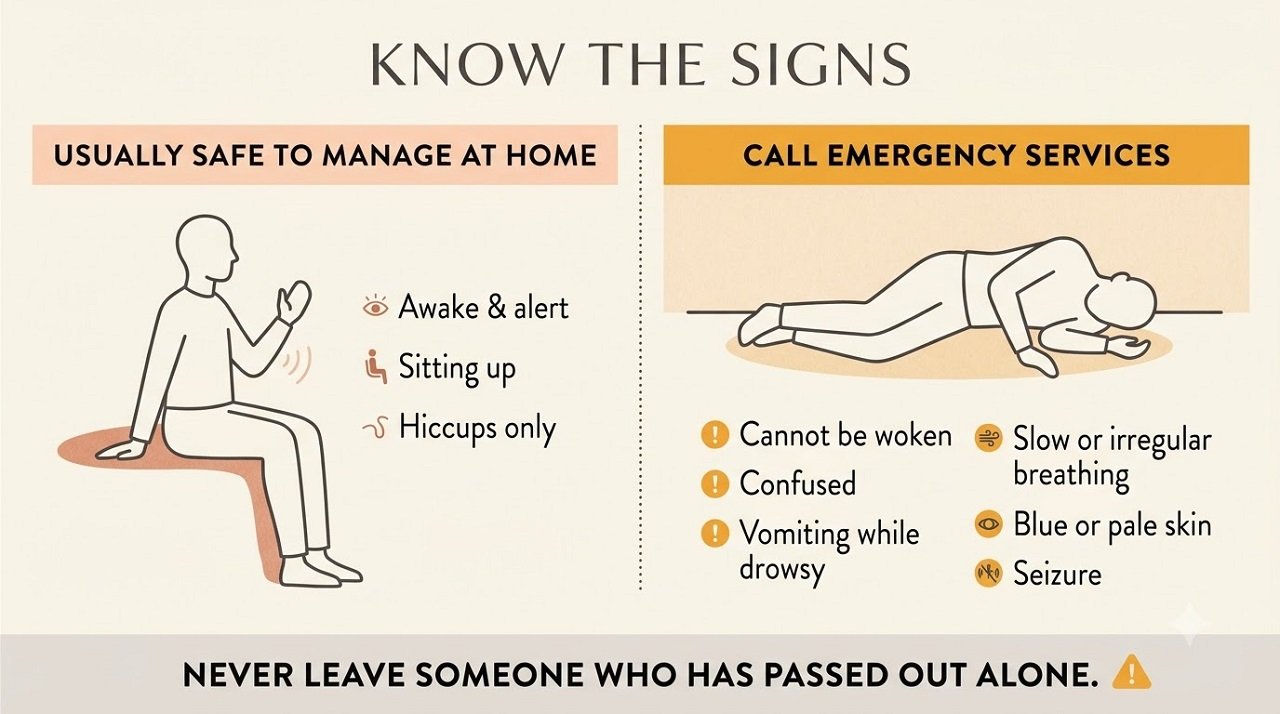
Also call emergency services if hiccups come with signs of a stroke (face drooping, arm weakness, trouble speaking) or a blood clot in the lung (sudden shortness of breath, chest pain) [2]. Get urgent medical care for chest pain, vomiting blood, black stools, or trouble swallowing or breathing.
Do not leave someone who has passed out alone, and do not give them food, sugar, or drinks to “stop the hiccups.” Alcohol dulls the gag reflex, so they can choke on vomit. Do not try to make them vomit. If they are being sick, keep them sitting up, or turn their head to the side if they must lie down [4].
After a few drinks, that sudden “hic” can sneak up on you and refuse to go away. It is annoying and uncomfortable, and it can turn a fun evening into a frustrating one. Alcohol can irritate your stomach and esophagus and fill your stomach with gas if the drink is fizzy, and both can set off the hiccup reflex in your diaphragm [1][2].
You can calm alcohol-induced hiccups with steady breathing, slow sips of cold water, or a small sour taste. None of these are guaranteed. Large reviews say that most hiccup remedies are based on small studies and experience rather than strong trials, so try the gentle ones first and be patient [1][2].
You can also prevent hiccups by drinking at a steady pace, staying hydrated, and avoiding carbonated alcoholic drinks that cause bloating. Cleveland Clinic lists alcohol, carbonated drinks, and eating or drinking too fast among the common triggers [2]. If hiccups last more than two days, or come with chest pain or trouble swallowing, see a healthcare professional to rule out other causes [1][2].
Key Takeaways
- Alcohol, fizzy drinks, and fast drinking can trigger hiccups by irritating the stomach and stretching it with gas.
- Gentle techniques such as slow sips of cold water and seated breath-holding may help, but evidence for any single remedy is limited.
- Never feed sugar, food, or liquid to someone who is very drunk, drowsy, or vomiting.
- Hiccups lasting more than 48 hours are called persistent, and more than one month are called intractable. Both need a doctor.
- Hiccups are not a diagnosis of an alcohol problem, but frequent heavy drinking is worth talking to a professional about.
Understanding Alcohol-Induced Hiccups
Alcohol-induced hiccups happen when drinking triggers the reflex that controls a sudden diaphragm contraction. They can develop after only a few drinks, especially if the drink is carbonated or consumed quickly. A stretched or irritated stomach and esophagus are the most common triggers [1][2].
What Are Hiccups?
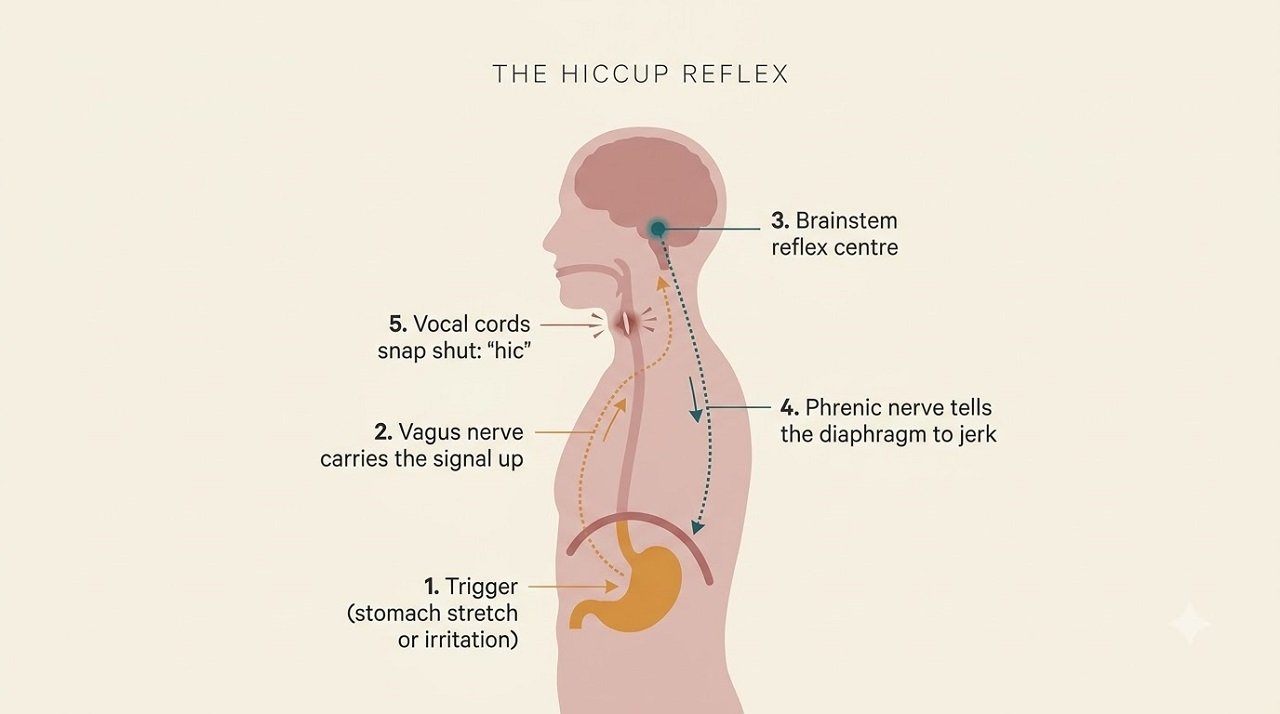
Hiccups are short, involuntary contractions of your diaphragm, the dome-shaped muscle beneath your lungs that helps you breathe. Each spasm is followed by your vocal cords closing briefly, creating the familiar “hic” sound. The hiccup reflex involves the phrenic nerve (which runs to the diaphragm) and the vagus nerve (which links the brainstem to the throat, chest, and stomach) [1][3].
Short-term hiccups often happen after eating or drinking too fast, swallowing air, or sudden temperature changes in your stomach. They usually stop within a few minutes to a few hours [1][2]. Hiccups that last longer than 48 hours are classed as persistent, and those that last more than a month are classed as intractable [1][2].
Table 1 shows the key parts of the hiccup reflex:
| Component | Function |
|---|---|
| Diaphragm | Contracts involuntarily, causing the hiccup |
| Phrenic nerve | Carries the signal to the diaphragm |
| Vagus nerve | Links the brainstem to the throat, chest, and stomach |
| Vocal cords | Close briefly to produce the “hic” sound |
How Alcohol Causes Hiccups
Several things can start the hiccup reflex when you drink. Alcohol can irritate the esophagus and stomach lining, and these nerves can send signals that set off the reflex. A large drink or fast drinking also stretches the stomach, which is one of the most common triggers of short-term hiccups [1]. Alcohol can also relax the valve at the bottom of the esophagus, which may let acid creep upward and irritate the area further, especially on an empty stomach [1].
Researchers do not fully understand every step, so the exact reason hiccups start after drinking is not settled. What we do know is that stomach stretching, carbonation, reflux, and swallowing air are all well-known triggers [1][2].
Key Factors That Trigger Hiccups After Drinking
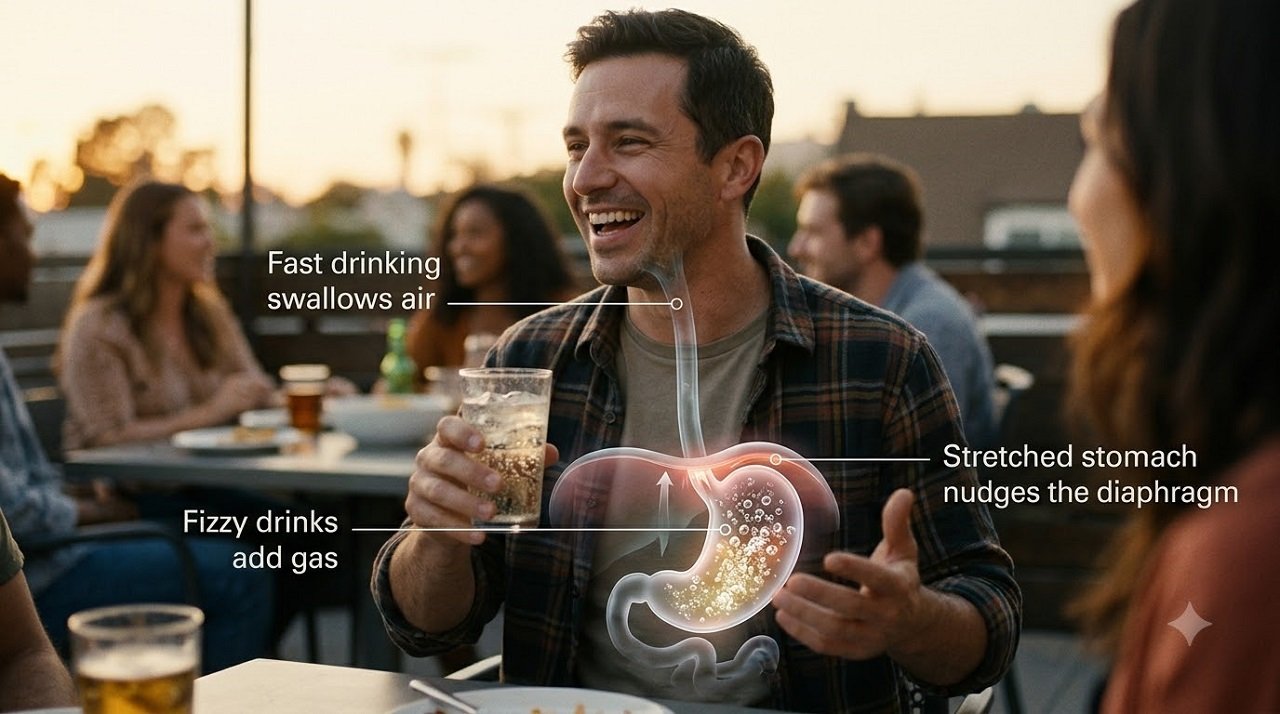
Certain habits and drink choices can raise your chances of hiccups after drinking:
- Fizzy drinks: Beer, sparkling wine, hard seltzers, and soda-based cocktails add gas to your stomach, which stretches it and can press on the diaphragm.
- Drinking fast: Gulping, shots, or talking and laughing while drinking make you swallow extra air.
- Drinking on an empty stomach: Without food, alcohol may irritate the stomach lining more.
- High-proof drinks: Strong spirits can irritate the esophagus and may add to acid reflux.
- Large meals with drinks: Overfilling the stomach is a known trigger on its own [1][2].
Simple changes such as sipping slowly, avoiding fizzy drinks, and eating before you drink can lower your risk.
Physiology: Nerves, Muscles, and Reflexes
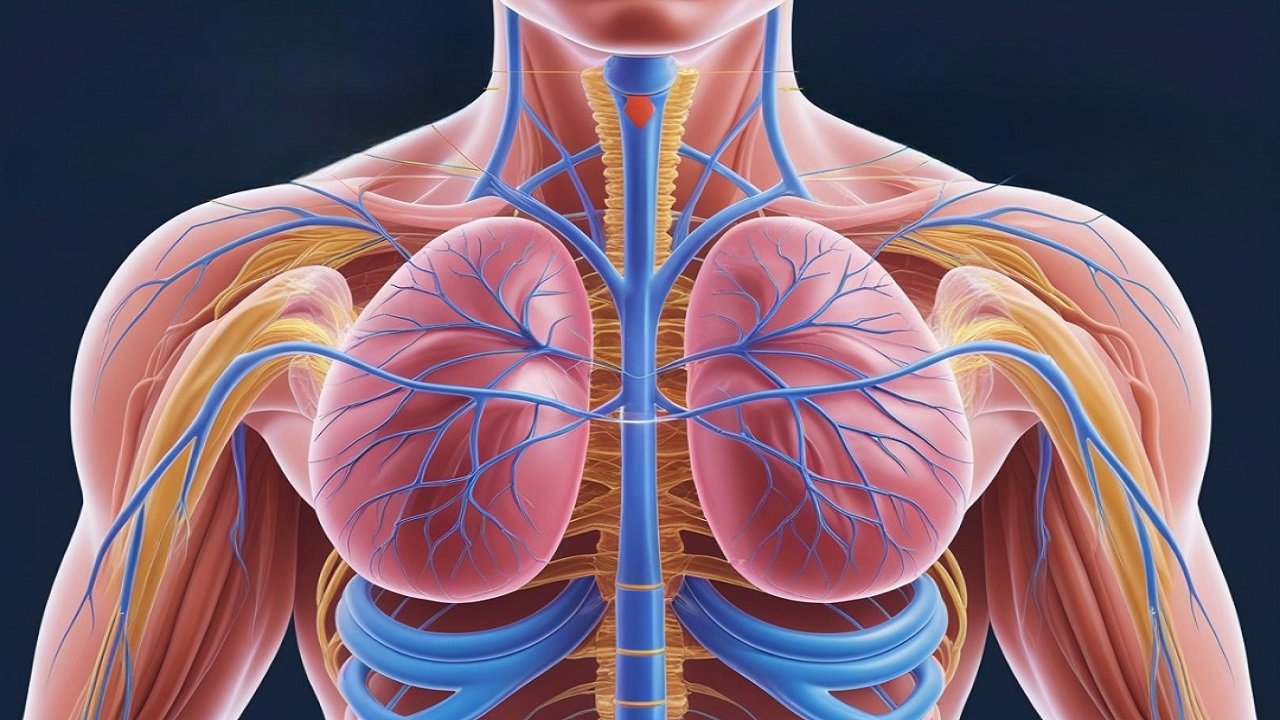
Understanding the reflex helps you see why certain remedies are tried. In short, a trigger in your stomach, esophagus, or chest sends a signal up to the brainstem, which fires a message down the phrenic nerve to jerk the diaphragm [1][3].
Role of the Diaphragm Muscle
Your diaphragm moves up and down as you breathe. During a hiccup, it contracts suddenly and involuntarily, causing a quick intake of air that is cut short when your vocal cords snap shut. Gas or fullness in the stomach, which sits just below the diaphragm, can nudge this reflex into action [1].
Involvement of Vagus and Phrenic Nerves
The vagus nerve runs from your brain through your neck to your digestive organs. The phrenic nerve branches from your neck to the diaphragm and controls its contraction. Together they form the main pathway of the hiccup reflex. Irritation along that route, from the stomach, esophagus, chest, or brainstem, can start hiccups or make them last longer [1][3].
| Nerve | Primary Function | Role in Hiccups |
|---|---|---|
| Vagus nerve | Regulates throat and digestive movements | Carries the trigger signal from the stomach and esophagus |
| Phrenic nerve | Controls diaphragm contraction | Delivers the “contract” message to the diaphragm |
Impact on the Hiccup Cycle
The cycle starts when nerves in your chest or abdomen send an unusual signal. This sets off an involuntary diaphragm contraction followed by the vocal cord closure. The reflex usually stops by itself once the trigger passes, such as when gas moves on or the stomach settles [1][2]. If you drink heavily over a long period, hiccups may become more frequent, and any hiccups that will not stop deserve a medical check [1].
Immediate Home Remedies to Stop Alcohol-Induced Hiccups
You can try simple actions that calm your diaphragm and reset your breathing rhythm. A medical review describes breath-holding, vagus-stimulating tricks, and cold drinks as typical first steps for short-term hiccups, but notes the evidence is mostly anecdotal [1][2]. If one does not work, try another, and do not push through anything that feels uncomfortable.
Safety first: Do these only if you are awake, alert, and sitting or standing upright. If you are very drunk, drowsy, nauseated, or vomiting, skip the remedies, sit up, and get help from a sober friend.
Holding Your Breath and Controlled Breathing
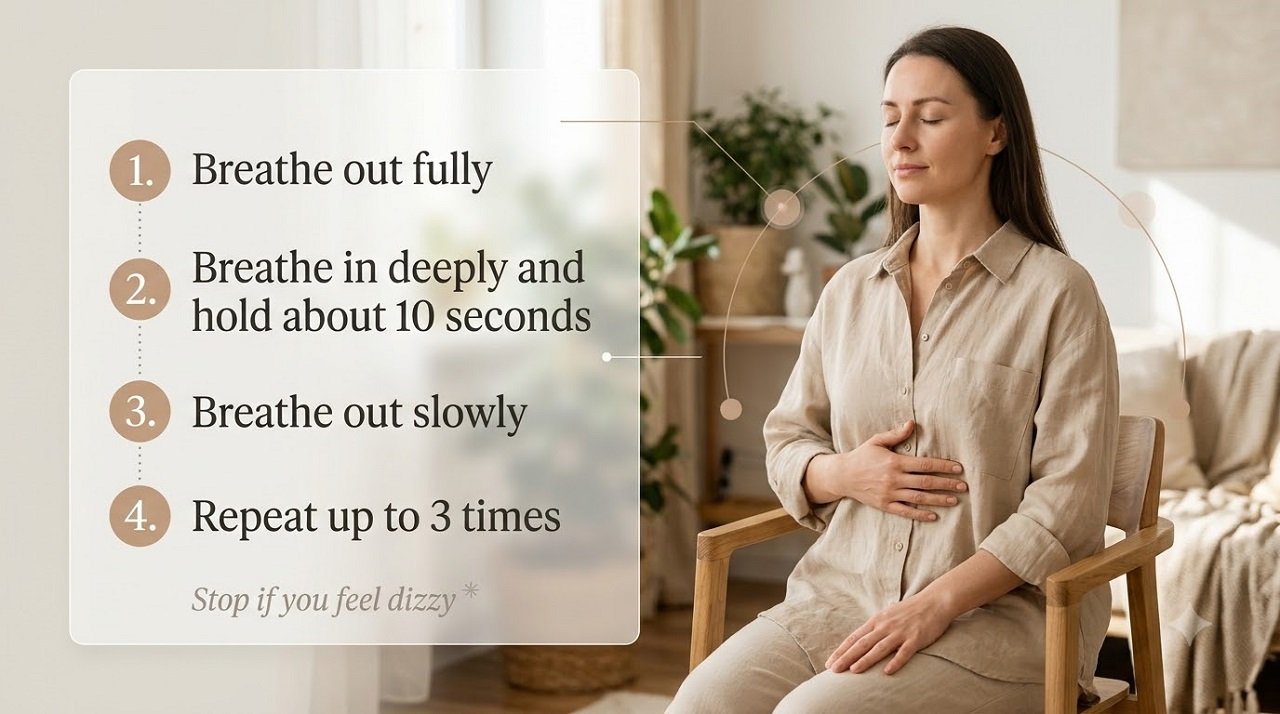
Holding your breath briefly raises carbon dioxide (CO₂) in your blood, which may help interrupt the hiccup reflex [1]. Take a deep breath and hold it for about 10 seconds, then breathe out slowly. Repeat two or three times.
- Valsalva maneuver: Breathe in, close your mouth, pinch your nose, and gently try to breathe out against the blockage for a few seconds. Do not strain hard. Skip this if you have heart disease or have been told to avoid straining [1].
- Paper bag breathing: Breathe slowly into a small paper bag (never plastic) for a few breaths. Stop right away if you feel dizzy, and avoid it if you have heart or lung conditions [2].
Sit down for all of these to avoid dizziness, and stop if you feel lightheaded.
Sipping Cold Water or Gargling

Slowly sipping cold water, or gargling it for about 30 seconds, is a common first step and is listed among the usual vagal stimulation methods [1][2]. Take small sips and swallow slowly, and sit or stand upright while you do it. Avoid gulping, very hot drinks, or fizzy drinks, which can add gas and make hiccups worse.
Stimulating the Vagus Nerve
The vagus nerve connects the brainstem to the throat and digestive organs, and some simple actions are thought to interrupt the hiccup reflex by stimulating it [1]. Gentle options include swallowing several times, gargling, or lightly pulling the tongue forward [1][2].
Some people also pull their knees to their chest while seated to relieve pressure on the stomach. This is a folk method and is not well studied. Do not use force, and do not press on your neck or eyes.
Taste and Throat Tricks
A sharp taste or textured food can change your swallowing rhythm and may break the cycle. Reviews list swallowing a spoonful of sugar, biting a lemon wedge, and sipping vinegar as traditional options [1][2].
- Use them only if you are fully alert and sitting upright. Choking is a real risk if you are very drunk or drowsy.
- Keep amounts small: one level teaspoon of sugar, a small lemon bite, or a few drops of vinegar. Undiluted vinegar and lemon can burn if you already have heartburn or reflux, so skip them in that case.
- A spoon of peanut butter is thick and sticky, so avoid it if there is any chance you could choke.
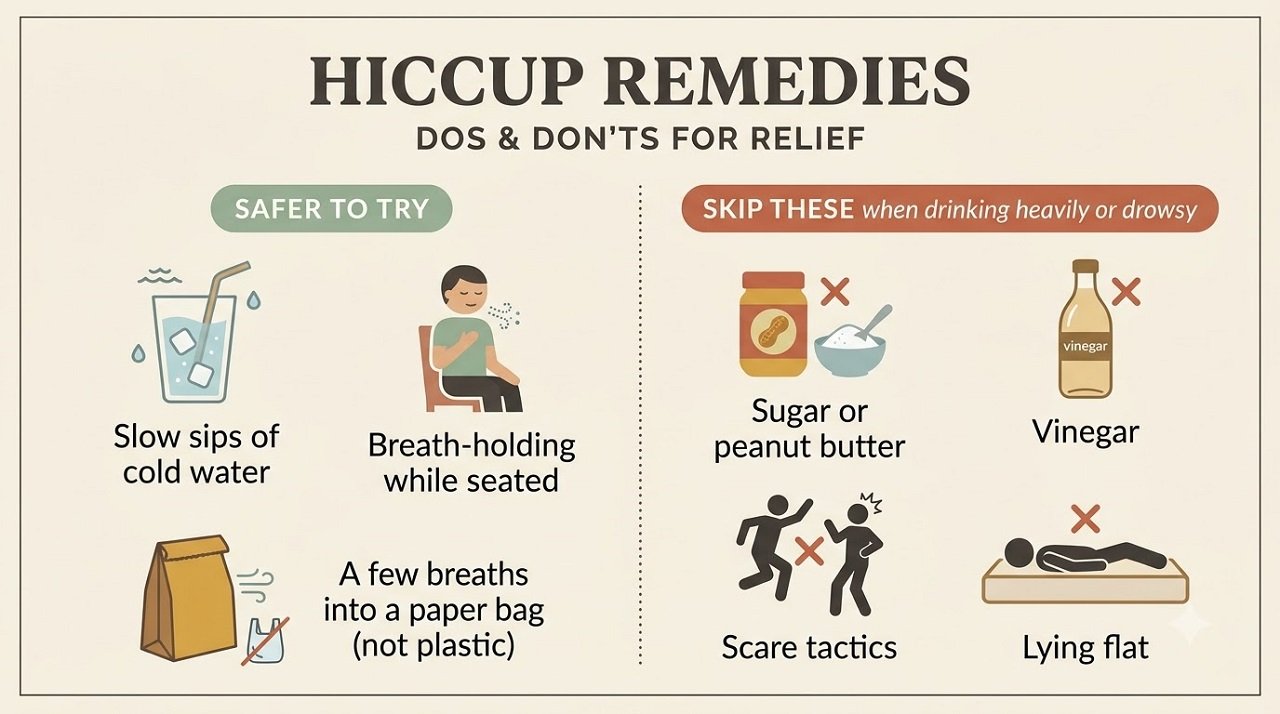
| Remedy | Safe if alert and upright? | Skip if |
|---|---|---|
| Slow sips of cold water | Yes | Very drowsy or vomiting |
| Seated breath-holding | Yes, a few repeats | Dizzy, or heart or lung condition |
| Paper bag breathing (paper only) | With care | Dizzy, or heart or lung condition |
| Teaspoon of sugar | With care | Very drunk, drowsy, or vomiting |
| Lemon or vinegar | With care | Heartburn, reflux, or sore throat |
| Sudden scare or shock | Not recommended | Not reliable and not safe for anyone |
Lifestyle and Prevention Strategies
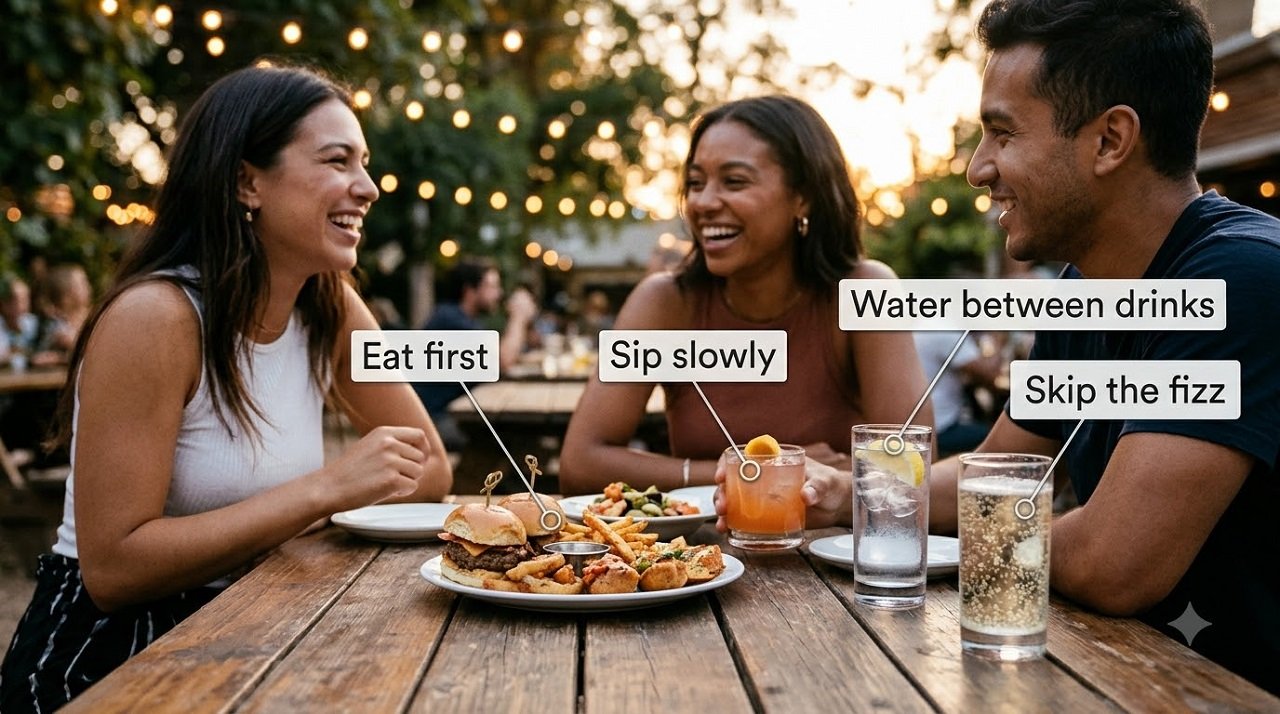
Simple habits can lower how often hiccups happen when you drink. Paying attention to what you drink, how fast, and what you eat beforehand makes the biggest difference.
Limiting Alcohol and Avoiding Triggers
Drinking less is the most dependable way to avoid hiccups and the many other effects of alcohol. Excess alcohol irritates the stomach and esophagus, and it can make acid reflux more likely, which is another known trigger for hiccups [1][2].
- Eat a meal before you drink, since food may buffer the stomach.
- Be careful with strong spirits on an empty stomach.
- If hiccups happen often, note what you drank, how fast, and whether it was fizzy so you can spot your own triggers.
Slowing Down Consumption
Drinking too quickly makes you swallow air and stretches the stomach. Take smaller sips and put your glass down between drinks. Alternate each alcoholic drink with a glass of water, which also helps with hydration. Eating small snacks while you drink may help too.
Choosing Non-Carbonated Drinks
Fizzy drinks put extra gas in your stomach, and Cleveland Clinic lists carbonated drinks as a common hiccup trigger [2]. If you tend to get hiccups, try still mixers such as juice or plain water instead of soda, tonic, or sparkling wine. Beer is carbonated too, so it can be a trigger for some people. There is no drink that is guaranteed to prevent hiccups, so pay attention to your own pattern.
When to Seek Medical Attention
Hiccups after drinking usually disappear on their own, but sometimes they last long enough to disrupt sleep, eating, or breathing. If so, a doctor can look for another cause.
Persistent and Intractable Hiccups
Hiccups are usually called persistent if they last longer than 48 hours, and intractable if they last more than a month [1][2]. Cleveland Clinic advises calling a healthcare provider if hiccups last longer than two days [2].
See a doctor if you also have:
- Hiccups for more than 48 hours
- Trouble eating, drinking, or sleeping
- Weight loss, repeated vomiting, or ongoing fatigue
- Hiccups that began after a head, neck, or abdominal injury or surgery
- Hiccups that began after starting a new medicine
Possible Underlying Health Issues
Long-lasting hiccups can come from conditions such as gastroesophageal reflux disease (GERD) or a hiatal hernia, problems of the brain or nervous system, kidney or metabolic problems, infections, and some medicines [1][3]. A doctor may suggest an exam and, when needed, blood tests, an endoscopy, or imaging to find the cause. If a cause is found, treating it often stops the hiccups. Persistent cases that need medicine are managed by a doctor, so do not try to self-medicate [3].
Recognizing Serious Complications
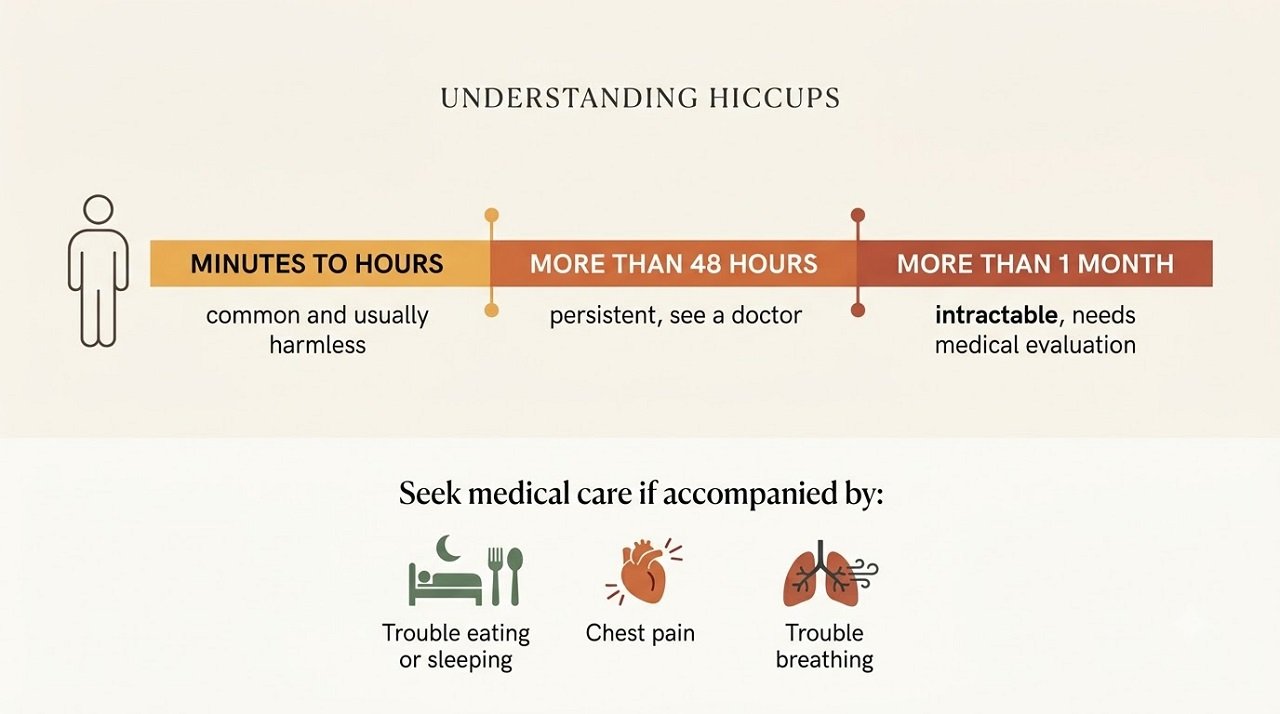
Hiccups themselves are not usually dangerous, but the situation around them can be. Get medical care promptly if hiccups come with:
| Warning Sign | Why It Matters |
|---|---|
| Hiccups lasting more than 48 hours | May point to an underlying cause that needs checking [1][2] |
| Chest pain or trouble breathing | Can be a sign of a heart, lung, or blood-clot problem and needs emergency care [2] |
| Vomiting blood, coffee-ground vomit, black stools | May signal bleeding in the digestive tract |
| Trouble swallowing liquids | Can lead to dehydration and needs evaluation |
| Vomiting while very drunk or drowsy | Choking on vomit is a risk, and this can mean alcohol poisoning [4] |
Alcohol Use, Hiccups, and Long-Term Implications
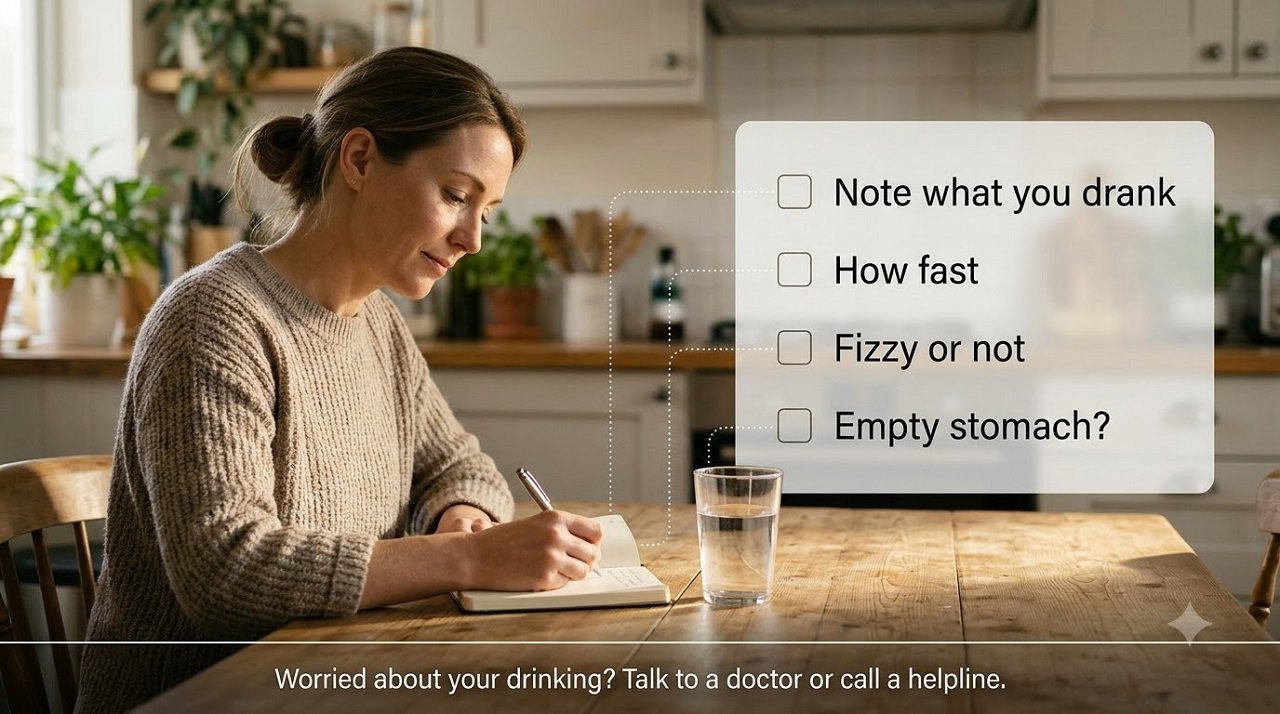
Hiccups after one or two drinks are usually a minor, passing annoyance, and they are not a medical sign of an alcohol problem. They do remind you how alcohol affects your stomach, nerves, and digestion.
Identifying Patterns and Risk Factors
If you often get hiccups after drinking, think about when and why. Drinking large amounts quickly, choosing fizzy drinks, or drinking on an empty stomach all raise stomach pressure.
| Type | Example | Possible Effect |
|---|---|---|
| Digestive irritation | Drinking high-proof spirits | Reflux and stomach upset |
| Rapid consumption | Shots or chugging | Extra gas and bloating |
| Bodily stress | Dehydration or exhaustion | Poorer comfort and control of breathing |
Alcohol Use Patterns and Getting Support
Hiccups alone are not a recognized sign of alcohol dependence. But if you find you often drink more than you planned, cannot cut down, or need to drink to feel normal, it is worth talking to a doctor or a counselor without judgment.
Important: if you drink heavily every day, do not stop suddenly on your own, because alcohol withdrawal can be dangerous and may cause seizures. Speak to a doctor about a safe plan first. In the United States, the SAMHSA National Helpline (1-800-662-4357) is free, confidential, and open 24/7 for information and referrals [5].
Emotional Triggers and Regulation
Alcohol may feel like it eases stress for a moment, but it can also lead to drinking more than you intended. Slow breathing, a glass of water, and a short break before the next drink are small steps that help you pace yourself. If stress or low mood is driving your drinking, a doctor or counselor can help.
Frequently Asked Questions
You can manage alcohol-induced hiccups by staying upright, sipping cold water, trying seated breathing techniques, and avoiding fizzy drinks. Most episodes pass by themselves, and see a doctor if they last more than two days [1][2].
What are the most effective breathing techniques to stop hiccups?
Breath-holding is the most commonly suggested one. Sit upright, breathe in deeply, hold for about ten seconds, then breathe out gently, and repeat a few times. The aim is to let carbon dioxide rise slightly, which may help the reflex settle [1]. Slow rhythmic breathing, such as five seconds in and five seconds out, may help you stay calm too. Stop if you feel dizzy.
Can a sudden scare or shock help cure hiccups?
There is no reliable evidence that a scare works, and it is not recommended. A startle might distract you for a moment, but it can also cause you to inhale sharply, fall, or choke if you are intoxicated. Safer methods are a better choice.
Are there any particular foods or drinks that can alleviate hiccups quickly?
Small amounts of sugar, lemon, or vinegar are traditional tricks and may work for some people, but evidence is limited [1][2]. Slowly sipping cold water is a gentler option. Use these only if you are alert and upright, and never give food or drink to someone who is very drunk, drowsy, or vomiting.
How long do alcohol-related hiccups typically last and when should I see a doctor?
Most episodes last from a few minutes to a few hours and stop once the trigger settles [2]. See a healthcare professional if they last more than 48 hours, or if you have chest pain, trouble breathing, trouble swallowing, or repeated vomiting [2].
What home remedies are recommended for treating hiccups?
Holding your breath briefly, sipping or gargling cold water, swallowing a spoonful of sugar, and breathing into a paper bag are all commonly listed, though Cleveland Clinic notes they rest mostly on anecdote rather than strong trials [2]. Pick one gentle method at a time, stay upright, and stop if you feel dizzy or unwell.
Does physical activity influence the duration or intensity of hiccups?
There is no firm research on this. Many people find it easier to stay seated or upright, since lying flat after drinking raises the risk of reflux and of choking if you vomit. Gentle upright activity such as slow walking is fine if you feel well.
Scientific References
- Steger M, Schneemann M, Fox M. Systemic review: the pathogenesis and pharmacological treatment of hiccups. Alimentary Pharmacology & Therapeutics 2015;42(9):1037–1050 (PubMed): https://pubmed.ncbi.nlm.nih.gov/26307025/
- Cleveland Clinic. Hiccups: causes, treatment, and when to see a provider: https://my.clevelandclinic.org/health/diseases/17672-hiccups
- Cole JA, Plewa MC. Singultus (hiccups). StatPearls (NCBI Bookshelf, National Library of Medicine), updated 2025: https://www.ncbi.nlm.nih.gov/books/NBK538225/
- Mayo Clinic. Alcohol poisoning: symptoms and causes: https://mayoclinic.org/diseases-conditions/alcohol-poisoning/symptoms-causes/syc-20354386
- Substance Abuse and Mental Health Services Administration (SAMHSA). National Helpline: https://www.samhsa.gov/find-help/helplines/national-helpline

Chia Seed Pudding for Constipation Relief: How Much to Use and How to Make It Safely

How Much Protein to Eat on GLP-1 to Prevent Muscle Loss

Train Your Immune System: An Exclusive Masterclass Premiere with Dr. Ryan Lazarus

PEMF Webinar

The 4-7-8 Breathing Technique: Step-by-Step Guide and What the Research Actually Shows

HBOT ( Hyperbaric Oxygen Therapy ) Webinar
-
 Events1 month ago
PEMF Webinar
-
 Natural Sleep Remedies5 months ago
The 4-7-8 Breathing Technique: Step-by-Step Guide and What the Research Actually Shows
-
 Events1 month ago
HBOT ( Hyperbaric Oxygen Therapy ) Webinar
-

 Events5 months ago
The Anti-Cancer Body with Dr. Michael Karlfeldt
-

 Events5 months ago
Why You Can’t Trust Big Pharma
-

 Home Remedies5 months ago
Natural Home Remedies for Restless Legs at Night
-

 Events4 months ago
The Cancer Conversation Your Oncologist Cannot Have in 15 Minutes
-

 Events6 months ago
Beyond the Brain